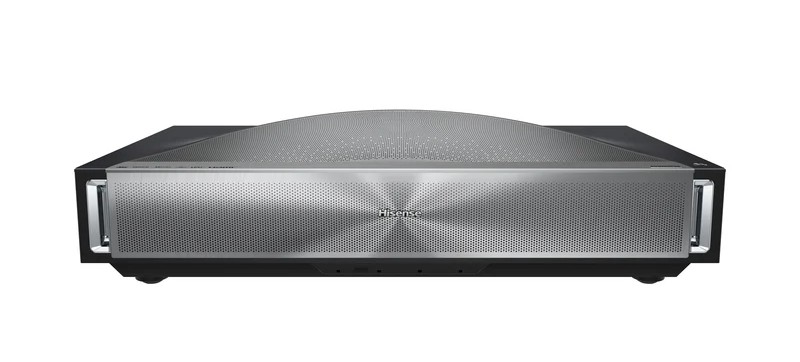
Hisense PX4 Pro Review: First 240Hz FreeSync UST Projector
Hisense has just pulled the trigger on the PX4 Pro, and it’s arguably the most important ultra-short-throw (UST) laser projector launch of the summer. Priced at $3,998 and now shipping, it’s the first UST projector in history to earn AMD FreeSync Premium certification — a distinction that, until now, belonged exclusively to gaming monitors. If you’ve ever wished your 120-inch “TV” could feel as responsive as a 27-inch gaming monitor, this is the projector built to prove it’s possible.
In this article, we’ll break down everything Hisense announced about the PX4 Pro: its TriChroma RGB laser engine, brightness and contrast numbers, gaming credentials, audio system, connectivity, pricing, and how it stacks up against the outgoing PX3-Pro and rivals like the Samsung Premiere and LG CineBeam Qube. We’ll also tell you exactly who should (and shouldn’t) buy it.
Hisense PX4 Pro: Quick Overview
- Brand: Hisense
- Product: PX4 Pro (4K RGB Triple-Color Laser Cinema)
- Category: Ultra-short-throw (UST) laser home theater projector
- Price: $3,998 MSRP
- Availability: On sale now in the United States, roughly $1,000 above the outgoing PX3-Pro
- Standout feature: First UST projector certified for AMD FreeSync Premium
- Brightness: 3,500 ANSI lumens
- Contrast: 6,500:1 native, with a 7-level adjustable iris
- Screen size: 80 to 200 inches
Design and Build
The PX4 Pro follows the boxy, low-profile silhouette that’s become the signature look for premium UST laser TVs. It measures 21.3 x 11.3 x 5.6 inches and weighs 18.3 pounds, so it’s meant to live permanently on a media console rather than get packed away after movie night. Because it’s a UST design, the lens sits at the front of the chassis and throws the image almost straight up onto the screen, which is what allows it to sit just inches from the wall instead of requiring 10+ feet of room like a traditional long-throw projector.
With a 0.20:1 throw ratio, the PX4 Pro can produce a 120-inch image while sitting roughly 11.7 inches from the wall. That’s a meaningful advantage for anyone in an apartment or a living room where a full-size home theater installation simply isn’t practical.
Display Technology: TriChroma RGB Laser Explained
At the core of the PX4 Pro is Hisense’s third-generation LPU Digital Laser Engine, paired with a 0.47-inch DLP chip (Texas Instruments’ DLP 8445). This is a single-chip DLP design, but instead of relying on a spinning color wheel and a phosphor wheel to generate color — the traditional approach used by cheaper laser and lamp projectors — it fires separate red, green, and blue laser diodes directly at the DMD chip in rapid sequence.
Why does this matter? Phosphor-based color wheels tend to degrade over years of use, gradually losing saturation and shifting color balance. A pure RGB triple-laser light source sidesteps that problem almost entirely, which is why Hisense is touting 118% coverage of the BT.2020 color space (an extremely wide, essentially TV-studio-grade color gamut) and a Delta E color accuracy rating of 0.9 or lower — a number so low it’s approaching reference-monitor territory, where anything under 1.0 is considered visually indistinguishable from perfect.
Brightness
Hisense rates the PX4 Pro at 3,500 ANSI lumens, a meaningful step up from the 3,000 ANSI lumens on the outgoing PX3-Pro. ANSI lumens is the industry’s more conservative, standardized brightness measurement (as opposed to the often-inflated CVIA or “lumens” figures some budget brands use), so this number should translate fairly directly to real-world performance. In practice, that’s bright enough to keep a 100- to 120-inch image watchable with some ambient light in the room, though for the full 200-inch image, you’ll still want to dim the lights for the best contrast.
Resolution and Contrast
The PX4 Pro is a native 4K projector (utilizing pixel-shifting technology from its DLP chip, as is standard across this price category) capable of scaling from 80 inches up to a genuinely massive 200 inches. Contrast is rated at 6,500:1, managed through a seven-level adjustable iris combined with Hisense’s proprietary Dynamic Grayscale Technology and an Enhanced Black Level Algorithm. For a UST projector — a category that has historically struggled with black levels compared to traditional long-throw laser projectors — that combination of hardware and software processing is what allows the PX4 Pro to claim genuinely deep shadow detail rather than the washed-out grays that plagued early UST models.
HDR and Picture Certifications
The PX4 Pro ships with a genuinely comprehensive HDR and cinema certification stack:
- Dolby Vision
- Dolby Vision Gaming
- Dolby Atmos
- IMAX Enhanced
- HDR10+
- HDR10
- HLG
- Filmmaker Mode
Having both Dolby Vision and HDR10+ covers the two competing dynamic HDR formats, meaning the projector should map high-dynamic-range content correctly regardless of whether you’re streaming from Netflix (Dolby Vision) or Amazon Prime Video (which frequently uses HDR10+).
Gaming Features: The Headline Act
This is where the PX4 Pro genuinely breaks new ground. It’s the first ultra-short-throw projector to be certified for AMD FreeSync Premium, a variable refresh rate (VRR) standard that eliminates screen tearing by synchronizing the display’s refresh rate with your GPU’s frame output. FreeSync Premium certification isn’t handed out casually — it requires a minimum of 120Hz at Full HD resolution and mandatory Low Framerate Compensation (LFC), a technique that repeats frames in a controlled pattern whenever your graphics card’s output drops below the display’s minimum refresh window, preventing stutter during demanding scenes.
The headline numbers: 1ms input lag at 1080p/240Hz, with 4K capped at 120Hz. For context, 1ms input lag and 240Hz refresh rates have historically been the exclusive domain of dedicated esports monitors — seeing those specs on a 120-inch projected image is a genuine first for the category.
Console gamers are well covered too. Two Ultra High-Speed HDMI 2.1 ports support Auto Low Latency Mode (ALLM), which automatically switches the display into its low-latency gaming picture mode the moment it detects a console. There are also two HDMI 2.0 ports and an ARC connection for a total of four HDMI inputs. Xbox Cloud Gaming runs natively through the built-in VIDAA smart platform, letting you stream Xbox titles without a console at all — Hisense says deeper integration is coming through a future software update.
Operating System and Smart Features
The PX4 Pro runs Hisense’s VIDAA smart TV platform, which ships with Netflix, Disney+, Hulu, Prime Video, and YouTube pre-installed. VIDAA has matured considerably over the past few years and now offers a genuinely competitive alternative to Google TV and Roku, particularly for streaming-first households that don’t want to add an external media player.
Audio
Sound comes from a 66-watt, six-speaker Dolby Atmos 4.0.2 system, including two upward-firing speakers for height-channel effects, and the whole array has been tuned by Devialet — the well-regarded French acoustics company known for its work in high-end audio. That’s a genuinely premium partnership for a projector at this price point, and it should mean the PX4 Pro is far more usable without a separate soundbar than most UST projectors, whose built-in speakers are often an afterthought.
Connectivity: WiFi, Bluetooth, USB, HDMI
- HDMI: 2x HDMI 2.1 (Ultra High-Speed, ALLM) + 2x HDMI 2.0 with ARC
- USB: USB 3.0 and USB 2.0
- Audio out: Optical (S/PDIF)
- Networking: Gigabit LAN, Wi-Fi 7, Bluetooth 5.4
- Wireless casting: AirPlay and Miracast supported
Wi-Fi 7 support is a notable inclusion — most projectors in this category still ship with Wi-Fi 6, so this is a forward-looking touch that should pay off as more homes upgrade their routers.
Throw Ratio and Projection Size
As covered above, the PX4 Pro’s 0.20:1 throw ratio means it can sit around 11.7 inches from the wall for a 120-inch image, scaling up to a 200-inch maximum image size. That’s an unusually short throw distance even by UST standards, which typically hover closer to 0.25:1.
Power Consumption and Noise Level
Hisense has not published official power draw or dB noise figures for the PX4 Pro at the time of writing. RGB triple-laser engines are generally more power-hungry than LED-based light sources, so expect operating power in the 250 to 350-watt range, in line with comparable premium UST laser TVs. We’ll update this article if Hisense publishes official figures.
Price and Availability
The Hisense PX4 Pro is priced at $3,998 and is on sale now in the United States, positioned roughly $1,000 above the outgoing PX3-Pro. That’s a meaningful jump, but it buys you a brighter laser engine, deeper contrast, Wi-Fi 7, and — critically — the FreeSync Premium certification that no rival UST projector currently offers.
PX4 Pro vs. PX3-Pro: What’s Actually Changed?
| Spec | PX3-Pro (outgoing) | PX4 Pro (new) |
|---|---|---|
| Brightness | 3,000 ANSI lumens | 3,500 ANSI lumens |
| Price | ~$2,998 | $3,998 |
| FreeSync Premium | No | Yes (industry first for UST) |
| Max refresh rate | Not certified for VRR | 240Hz at 1080p, 1ms input lag |
| Wi-Fi | Wi-Fi 6 | Wi-Fi 7 |
| Audio | Standard integrated speakers | 66W Devialet-tuned Dolby Atmos 4.0.2 |
PX4 Pro vs. the Competition
| Projector | Price | Brightness | FreeSync Premium | Audio |
|---|---|---|---|---|
| Hisense PX4 Pro | $3,998 | 3,500 ANSI lumens | Yes | 66W Devialet 4.0.2 |
| Samsung Premiere (LSP9T) | ~$5,000–$6,000 | Similar tier | No | Integrated 4.2.2 |
| LG CineBeam Qube (HU710PB) | ~$5,000–$6,000 | Similar tier | No | Integrated 2.2 |
At $3,998, the PX4 Pro undercuts both the Samsung Premiere and LG CineBeam Qube by roughly $1,000 to $2,000, while being the only one of the three built specifically around adaptive-sync gaming. If competitive picture quality and console/PC gaming performance both matter to you, the PX4 Pro currently has no direct rival at its price.
Who Should Buy the Hisense PX4 Pro?
- Console and PC gamers who want a genuinely massive, tear-free gaming display without buying a 100-inch+ TV panel.
- Apartment dwellers and space-constrained rooms where a traditional long-throw projector setup isn’t feasible.
- Movie and sports fans who want a big-screen experience with strong HDR support and don’t want to run a separate sound system.
- Anyone upgrading from an older UST projector who has been waiting for meaningfully better contrast and color accuracy.
Who Should Skip It?
- Buyers on a tight budget — $3,998 is a serious investment, and cheaper UST and portable projectors exist for a fraction of the price.
- Home theater purists who prioritize absolute black levels over gaming performance; dedicated long-throw laser projectors still generally out-contrast UST designs.
- Anyone needing official noise and power-consumption figures before purchasing — Hisense hasn’t published these yet.
Pros and Cons
Pros
- First UST projector certified for AMD FreeSync Premium
- Genuinely elite 1ms input lag and 240Hz support at 1080p
- Wide 118% BT.2020 color coverage with excellent Delta E accuracy
- Full HDR certification stack, including both Dolby Vision and HDR10+
- Premium Devialet-tuned 66W Dolby Atmos audio
- Wi-Fi 7 and four HDMI ports, two of them full-bandwidth HDMI 2.1
- Undercuts Samsung and LG rivals on price
Cons
- $1,000 price increase over the outgoing PX3-Pro
- 4K gaming capped at 120Hz (240Hz is 1080p-only)
- No official noise-level or power-consumption specs published yet
- UST black levels, while improved, still trail dedicated long-throw laser projectors
Market Impact
The PX4 Pro’s FreeSync Premium certification is a genuinely significant milestone for the projector industry. Gaming-focused buyers have long treated projectors as a compromise — great for movie night, but laggy and tear-prone for competitive or fast-paced games. By bringing a monitor-grade VRR certification to a 120-to-200-inch UST projector, Hisense is directly targeting the growing crossover audience between home theater enthusiasts and PC/console gamers, a segment that brands like BenQ and Optoma have chased with dedicated “gaming projector” lines but rarely paired with genuine home-cinema-grade picture quality and audio in one box.
Expect rivals including XGIMI, JMGO, and AWOL Vision to respond with their own VRR-certified UST models within the next product cycle, especially with CEDIA and IFA both landing later this year.
Future Availability
The PX4 Pro is currently available in the United States. Given Hisense’s global distribution pattern with prior PX-series models, international availability in Europe, the UK, and other markets should follow within the next few months, though Hisense has not published an official international rollout schedule.
Frequently Asked Questions
Is the Hisense PX4 Pro worth buying?
If you want a single device that handles both premium home cinema and serious gaming on a massive screen, the PX4 Pro is currently the best UST projector for that specific combination, thanks to its FreeSync Premium certification, wide color gamut, and Devialet-tuned audio. If gaming performance isn’t a priority, it’s worth comparing against cheaper UST models that offer similar picture quality without the VRR premium.
How does the PX4 Pro compare to the PX3-Pro?
The PX4 Pro is brighter (3,500 vs. 3,000 ANSI lumens), adds FreeSync Premium certification and Wi-Fi 7, and upgrades to a Devialet-tuned 66W audio system — all for roughly $1,000 more than the PX3-Pro’s launch price.
Can the PX4 Pro really run games at 240Hz?
Yes, but only at 1080p resolution; 4K gaming is capped at 120Hz. The 1ms input lag figure is also specific to the 1080p/240Hz mode.
What’s the difference between FreeSync Premium and standard VRR?
FreeSync Premium is a stricter AMD certification tier that requires a minimum of 120Hz at Full HD and mandatory Low Framerate Compensation, a frame-repeating technique that prevents stutter when frame rates drop below the display’s minimum refresh window. It’s a meaningfully higher bar than basic, uncertified VRR support.
Does the PX4 Pro support Xbox and PlayStation consoles?
Yes. It has Auto Low Latency Mode over HDMI 2.1 for automatic console detection, and Xbox Cloud Gaming runs natively through the built-in VIDAA platform without needing a console at all.
Final Verdict
The Hisense PX4 Pro is one of the more genuinely newsworthy projector launches of 2026 — not because of a brightness or resolution war, but because it’s the first projector to bring monitor-grade adaptive-sync gaming certification to the ultra-short-throw category. Combined with a wide-gamut RGB laser engine, a full HDR certification stack, and Devialet-tuned Dolby Atmos audio, the PX4 Pro positions itself as the rare projector that’s equally credible for movie night and competitive gaming. At $3,998, it undercuts the Samsung Premiere and LG CineBeam Qube while offering a feature neither can currently match. For gamers who’ve been waiting for a “big-screen gaming monitor,” this is it.