Dangbei RX10 Review Preview: A Gimbal-Mounted Laser Projector That Runs on a Power Bank
Editorial note: Dangbei officially listed the RX10 on August 22, 2026. This is a product spotlight, not breaking news — we’re covering it now because the specs are fully confirmed and worth a closer look, not because it just happened.
Dangbei RX10 Review Preview: A Gimbal-Mounted Laser Projector That Runs on a Power Bank
Dangbei has quietly become one of the most prolific projector brands of 2026, and the RX10 is its latest attempt to win over buyers who want a laser projector that doesn’t need to live in one fixed spot. It’s a mid-range 1080p model built around a movable gimbal stand, a compact laser light engine, and — its most unusual trick — the ability to run off a portable power bank instead of a wall outlet.
Right now, the RX10 is only confirmed for the Chinese market, listed on JD.com at 5,499 yuan, which converts to roughly $818 USD at current exchange rates. There’s no confirmed international release yet, so treat U.S. or European availability as unannounced rather than “coming soon.”
Here’s everything it offers, how it compares to Dangbei’s own lineup and its closest rivals, and who it’s actually built for.
Design — Built to Move, Not Just to Sit
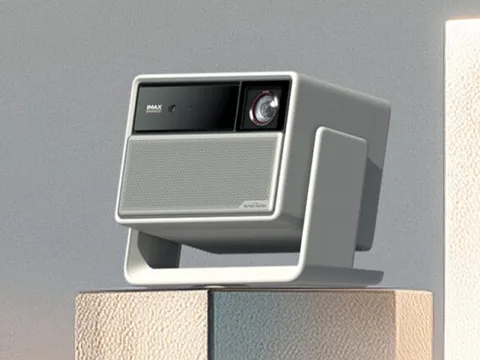
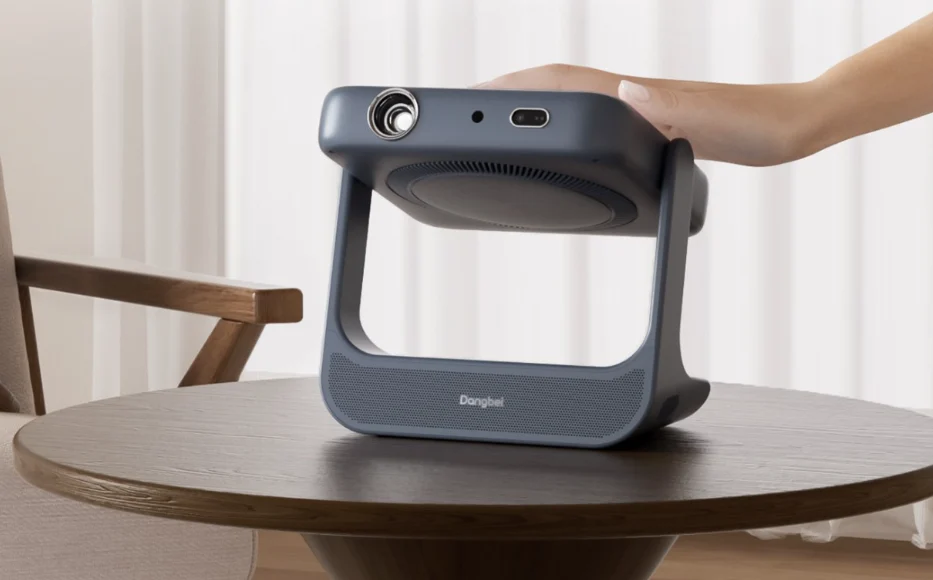
The RX10’s defining feature is its 225-degree vertical gimbal, which lets the lens rotate from pointing flat at a wall to tilting almost straight up at a ceiling. That range is wide enough to cover most casual use cases: propped on a coffee table aimed at a wall, set on the floor aimed upward for a lie-down movie night, or angled at an odd surface in a room that wasn’t designed with a projector in mind.
The housing is a mix of glass, polycarbonate, resin, and carbon steel, and the whole unit weighs about 2.1 kilograms (4.6 pounds). That’s light enough to carry room to room, though it’s not a true grab-and-go pocket projector — it’s built more for “move it occasionally” than “take it everywhere.”
Why this matters: A fixed-mount projector forces you to commit to one wall and one distance. A gimbal design like this one removes that commitment, which is a genuine convenience for renters, small apartments, or anyone who rearranges furniture more than once a year.
Automated Setup Features
Because the RX10 is designed to be repositioned often, Dangbei built in the automation to match:
- Auto-focus — refocuses the image automatically after you move the projector
- Obstacle avoidance — detects objects in the projection path
- Automatic keystone correction — squares up the image if the projector isn’t sitting perfectly level or centered
Why this matters: Manual keystone correction is one of the most common frustrations first-time projector owners run into — a slightly crooked image, wasted resolution from digital cropping, or a trapezoid-shaped picture. Automating that step removes the single biggest friction point for casual use.
Display Technology, Brightness, and Resolution
The RX10 uses a 0.33-inch DMD (Digital Micromirror Device) chip — the core imaging component in any DLP-based projector — to produce a native 1080p (1920×1080) resolution. It will accept a 4K input signal, but it downscales that signal to its native 1080p panel rather than displaying true 4K detail. That’s an important distinction: “accepts 4K input” and “is a 4K projector” are not the same claim, and Dangbei is careful not to conflate the two here.
Brightness comes from an ALPD 2 laser light source, rated at 1,200 CVIA lumens (Dangbei also states this is equivalent to 1,200 ISO lumens). ALPD (Advanced Laser Phosphor Display) is a laser-phosphor lighting technology that’s become common in Chinese-market projectors as a middle ground between cheaper LED engines and pricier full RGB triple-laser setups — it offers better brightness and color consistency than LED without the cost of a true tri-laser system.
The lens is a fixed-focus design with a 1.2:1 throw ratio, meaning for every foot of distance between the projector and the wall, you get roughly 1.2 feet of image width. That’s a fairly standard ratio for a mid-range home projector, not an ultra-short-throw design.
Why this matters: At 1,200 CVIA lumens, the RX10 is squarely a dim-room or evening-use projector. It’s bright enough for a dark living room after sunset, but it will struggle to produce a punchy image in a sunlit room with the curtains open. Compare that to Dangbei’s own D7X Pro Super Bright Edition, which pushes 1,700 CVIA lumens from a full triple-laser engine — a meaningfully brighter option if daytime viewing matters to you.
HDR and Motion Handling
The RX10 supports HDR10 and HLG decoding, along with MEMC (Motion Estimation, Motion Compensation) for smoother handling of fast-motion content like sports or action scenes.
Why this matters: HDR support widens the effective contrast and color range on compatible streaming content, though how much visible benefit you get depends heavily on the projector’s actual brightness ceiling — HDR tends to shine brightest (literally) on higher-lumen projectors, so treat this as a nice-to-have rather than the RX10’s headline feature.
Operating System and Processing
Inside, the RX10 runs on a MediaTek MT9669 processor with 3GB of RAM and 32GB of internal storage, powered by Dangbei OS 5.0, an Android-based smart TV interface. That’s a modest but workable spec sheet for a smart projector — enough to run common streaming apps smoothly without being a gaming powerhouse.
Gaming Features
Dangbei hasn’t marketed the RX10 as a gaming projector, and the spec sheet backs that up — there’s no mention of VRR, ALLM, or a high refresh-rate gaming mode. If gaming performance is a priority, this isn’t the model to shop for; look instead at projectors explicitly marketed with gaming-specific refresh rates and low input lag, such as XGIMI’s Z9X series.
Audio
The RX10 packs two 6-watt speakers into the base of its gimbal stand, angled upward by 15 degrees specifically to avoid the sound bouncing flatly off whatever surface it’s sitting on. It’s a small but thoughtful acoustic touch for a projector this size.
For anyone who wants better sound, the HDMI 2.1 port supports eARC, letting you pass audio out to a soundbar or AV receiver instead of relying on the built-in drivers.
Connectivity — WiFi, Bluetooth, USB, HDMI
| Connection | Spec |
|---|---|
| Wi-Fi | Wi-Fi 6 |
| Bluetooth | Bluetooth 5.0 |
| HDMI | 1x HDMI 2.1 (with eARC) |
| USB | 1x USB 2.0 |
Why this matters: A single HDMI port and a single USB port is a lean port selection. If you’re running multiple devices — a streaming box, a game console, and a laptop, for example — you’ll need an external HDMI switch, since there’s no built-in way to swap sources without unplugging cables.
Power Consumption and the Power Bank Feature
The RX10 ships with a 110-watt wall adapter and draws roughly 90 watts during normal use — reasonably efficient for a laser projector in this brightness class.
Its standout feature is power bank mode, which lets the projector run off a portable battery pack instead of a wall outlet. There are two catches worth knowing before you count on this feature:
- The power bank must support at least 45 watts of output via USB-C Power Delivery (PD).
- You need Dangbei’s specific USB-C adapter cable to actually use the feature — a generic USB-C cable reportedly won’t work the same way.
Why this matters: This is a genuinely useful feature for backyard movie nights, camping, or anywhere without a nearby outlet, but it’s not as plug-and-play as it sounds. Budget for Dangbei’s proprietary cable and a power bank that meets the 45W PD threshold, or the feature won’t function as advertised.
Noise Level, Throw Ratio, and Projection Size
Dangbei hasn’t published an official noise-level (dB) rating for the RX10 in its initial spec sheet, so we can’t state a number here without guessing. The throw ratio, as noted above, is a fixed 1.2:1, which is standard mid-throw territory — plan for the projector to sit a moderate distance from your screen or wall rather than right up against it (UST) or far across the room (long-throw).
Price and Availability
- Price: 5,499 yuan (~$818 USD)
- Availability: Currently listed on JD.com in China only
- International release: Not yet announced
If you’re outside China, there’s no official path to buy the RX10 today. Watch for a possible international listing announcement, but don’t assume one is coming — plenty of Dangbei’s China-market releases stay regional.
How the RX10 Compares to Dangbei’s Own Lineup
Dangbei launched two other notable projectors in the same window as the RX10, and the contrast is useful for figuring out where the RX10 actually fits:
| Model | Light Source | Brightness | Resolution | Standout Feature |
|---|---|---|---|---|
| Dangbei RX10 | ALPD 2 laser | 1,200 CVIA lumens | Native 1080p | 225° gimbal + power bank mode |
| Dangbei D7X Pro (Super Bright Edition) | Triple laser | 1,700 CVIA lumens | 4K | Meaningfully brighter output |
| Dangbei Redmi Projector 5 (related market segment) | LED | 400 CVIA lumens | Native 1080p | Budget entry point (~$148) |
The RX10 sits in the middle of Dangbei’s range: brighter and more feature-rich than its budget entry-level models, but noticeably dimmer and lower-resolution than its flagship D7X Pro tier.
How the RX10 Compares to the Competition
The mid-range portable laser projector segment is crowded right now, with XGIMI, Hisense/Vidda, and Xiaomi all fighting for the same buyers. Here’s a general positioning comparison:
| Model | Brand | Brightness | Resolution | Notable Extra |
|---|---|---|---|---|
| Dangbei RX10 | Dangbei | 1,200 CVIA lumens | 1080p | Power bank compatibility |
| XGIMI Z9X 4K High Brightness Edition | XGIMI | 1,600 CVIA lumens | 4K | RGB laser, 120Hz gaming mode |
| Hisense Vidda LightGo | Hisense | Not specified (triple laser) | 1080p | Built-in 20,000mAh battery, outdoor-rated |
Two things stand out from this comparison. First, XGIMI’s Z9X beats the RX10 on both brightness and resolution at a similar price tier, which is a real consideration if outright picture quality matters more to you than gimbal flexibility. Second, Hisense’s Vidda LightGo takes the “portable power” idea a step further with a battery built directly into the unit, rather than requiring an external power bank and a proprietary cable.
Who Should Buy the Dangbei RX10
Good fit for:
- Buyers who move their projector between rooms or setups regularly
- Anyone who wants a laser projector under $850 without committing to a fixed installation
- People who occasionally want to project outdoors or off-grid and already own a compatible power bank
Not a good fit for:
- Buyers who need 4K resolution — this is a 1080p panel that merely accepts 4K input
- Anyone shopping specifically for gaming performance
- Daytime or brightly lit room use, where 1,200 CVIA lumens will look washed out
- International buyers who need a projector today — it isn’t confirmed outside China yet
Pros and Cons
Pros:
- 225-degree gimbal offers genuine placement flexibility
- Automated focus, obstacle avoidance, and keystone correction reduce setup friction
- Power bank support adds real off-grid usability, if you have the right cable and battery
- eARC HDMI lets you upgrade audio easily
- Competitive price for a laser-based light engine
Cons:
- 1080p native resolution, not true 4K, despite accepting a 4K signal
- Only one HDMI port and one USB port
- Power bank mode requires Dangbei’s proprietary cable and a 45W+ PD-capable battery
- No official noise-level rating published
- Not currently available outside China
Final Verdict
The Dangbei RX10 is a sensible, well-thought-out mid-range projector for anyone who values flexibility over raw picture quality. The gimbal and automated setup features genuinely solve real annoyances that come with moving a projector between rooms, and the power bank option — cable requirement aside — is a legitimately useful addition for outdoor or off-grid use.
Where it comes up short is resolution and brightness relative to some of its closest same-price competitors, particularly XGIMI’s Z9X. If 4K clarity or gaming performance matter to you, this isn’t the pick. But if you want a laser projector you can genuinely move around your home — or occasionally take outside — the RX10’s feature set justifies its price, provided Dangbei brings it to international markets.
Predicted availability: No international launch has been confirmed. Based on Dangbei’s typical rollout pattern for recent models, an international listing — if one comes — would most likely arrive within a few months of the China launch, but this is speculation, not a confirmed timeline.
FAQ
Q: How much does the Dangbei RX10 cost?
A: It’s listed at 5,499 yuan in China, which converts to approximately $818 USD. No international pricing has been announced.
Q: Is the Dangbei RX10 a 4K projector?
A: No. It has a native 1080p resolution and will accept a 4K input signal, but it does not display true 4K detail.
Q: Can the Dangbei RX10 really run off a power bank?
A: Yes, but only with a power bank rated for at least 45W USB-C Power Delivery output, and only using Dangbei’s specific USB-C adapter cable.
Q: Is the Dangbei RX10 good for gaming?
A: It’s not marketed or specced as a gaming projector — there’s no VRR, ALLM, or high-refresh gaming mode listed.
Q: Where can I buy the Dangbei RX10?
A: Currently only through JD.com in China. No international retail listing has been confirmed.
Q: How does the RX10 compare to the Dangbei D7X Pro?
A: The D7X Pro is brighter (1,700 vs. 1,200 CVIA lumens) and offers native 4K resolution, making it the better pick for picture quality. The RX10’s advantage is its gimbal flexibility and power bank support.
Conclusion
The Dangbei RX10 isn’t trying to be a flagship — it’s a practical, mid-priced laser projector built around flexibility rather than spec-sheet bragging rights. Its 225-degree gimbal and automated setup tools solve real friction points for casual and semi-mobile use, and the power bank feature adds a genuinely useful option for anyone who wants to project outside the usual living-room setup. Just go in with realistic expectations on resolution and brightness, and keep an eye out for an international release before assuming you can buy one outside China.