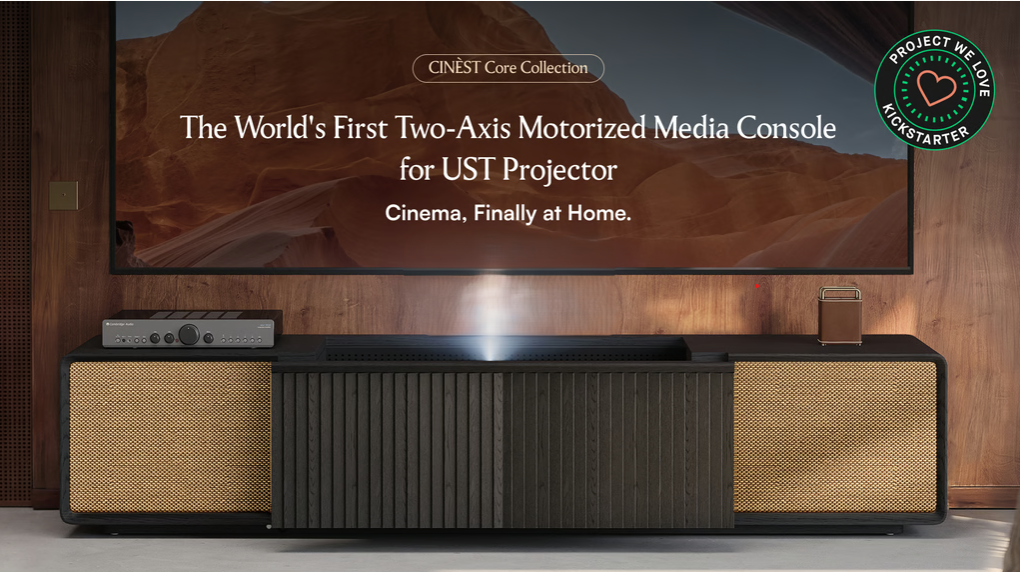
CINÈST Core Collection: The Motorized Cabinet Built for UST Projectors
If you’ve ever set up an ultra short throw (UST) projector, you already know the dirty secret nobody puts in the marketing photos: getting that razor-sharp, perfectly rectangular image takes fussy, finicky work. Move the projector two centimeters, and your image skews. Bump the cabinet, and you’re back to square one with the keystone settings. Add in a jungle of HDMI, power, and soundbar cables, and even a laser projector can end up looking like a science fair project instead of a home theater centerpiece.
That’s the exact problem a new company called CINÈST is trying to solve — not with a new projector, but with a new piece of furniture built specifically around one.
CINÈST, a home entertainment brand from consumer electronics company POVISON, has announced its debut product line, the Core Collection, and launched it on Kickstarter. Rather than another 4K laser projector chasing the brightness wars, this is a UST projector cabinet system: a motorized console designed to hold, align, cool, and hide the cabling for the ultra short throw projector you already own.
It’s a narrower, more specific idea than most projector news, and that’s exactly why it’s worth understanding. As UST projectors from brands like Epson, Hisense, LG, Samsung, XGIMI, AWOL Vision, and Optoma have become the fastest-growing category in home cinema, the furniture and infrastructure around them has largely been an afterthought. CINÈST is betting that’s about to change.
What Exactly Is the CINÈST Core Collection?
Let’s be precise about what this product is and isn’t, because the category is genuinely new enough to cause confusion.
The Core Collection is not a projector. It doesn’t project an image, and it has no lamp, laser light source, lens, or DLP/LCD imaging chip of its own. Instead, it’s a media console with a built-in, motorized platform designed to hold a UST projector you supply — whether that’s an Epson, Hisense, Samsung, LG, or another compatible ultra short throw model.
Think of it the way you’d think of a high-end TV wall mount or a turntable plinth: it’s precision-engineered supporting infrastructure for a piece of tech you already own, not the tech itself. According to CINÈST, the system is compatible with roughly 99% of UST and laser projectors currently on the market, and it’s designed to support screen sizes from 80 to 200 inches.
The line currently includes three models — referred to as Core A1, Core C1, and Core E1 — spanning different finishes, sizes, and price points, from a more accessible entry cabinet to a luxury version with premium materials and hidden storage.
Why This Category Exists Now
To understand why a projector cabinet company exists in 2026, it helps to understand what’s happened to the projector market over the last few years.
UST projectors solved the biggest historical objection to projector-based home theater: the need for a long throw distance and a ceiling mount. By bouncing light off a mirror array positioned just inches from the screen, UST models let you place the projector directly beneath or in front of your screen, much like a traditional television console. That single change opened projectors up to a completely new type of buyer — people who wanted a huge, cinematic image without gutting their living room for a projector booth and a drop-down screen.
The catch is that UST optics are dramatically more sensitive to placement than long-throw projectors. Because the image is being thrown from such a short, steep angle, even minor misalignment — a shifted piece of furniture, an uneven floor, a couch that got bumped during a move — can visibly warp the picture. Most UST owners fix this with manual keystone correction in software, which technically squares the image but sacrifices sharpness and brightness because it’s digitally stretching pixels rather than optically aligning them.
CINÈST’s pitch is that hardware-level alignment, handled by motors instead of software, is the better fix. That’s the whole premise behind the flagship feature of the Core Collection.
Design and Build
CINÈST is positioning the Core Collection less like typical AV gear and more like design-forward furniture — the kind of piece an interior designer would choose, not just an AV installer. The company frames its target buyer as someone who wants a large-screen home theater experience without the space looking like a technical installation.
That shows up in a few concrete ways:
- Acoustically transparent fabric panels on the side cabinets, which hide speakers and storage while still letting sound pass through cleanly
- Multiple finish and material options across the A1, C1, and E1 models, including options like rounded oak-style detailing on the E1
- Adjustable shelving inside the side cabinets, reportedly offering multiple height levels for different equipment
- A removable back panel for easier cable routing and access after installation
This is a meaningfully different approach from the standard “black MDF box with a hole cut in it” that has defined projector furniture until now. Whether that design language is worth a premium price is something buyers will have to judge for themselves once units start shipping.
The 4-Way Rapid Precision Platform: The Core Feature
The centerpiece of the system — and the reason CINÈST calls this a “cabinet system” rather than just a stand — is what it calls the 4-Way Rapid Precision Platform.
Here’s how it’s designed to work: instead of manually nudging your projector left, right, forward, or back every time it gets bumped, the platform adjusts along four axes using small motors. Once you’ve achieved a perfectly aligned image, you save that position with a single click. If the projector ever gets knocked out of alignment — during cleaning, a piece of furniture shifting, or general vibration — you can restore the exact saved position at the press of a button instead of re-doing manual keystone correction from scratch.
This matters more than it might sound like on paper. Manual keystone correction is a genuine pain point for UST owners, and it’s one of the more common complaints in projector owner communities. A hardware-based “memory position” system is a legitimately clever way to attack that problem, assuming it holds up to real-world testing once backers actually receive units.
Other core features rounding out the system include:
- Integrated cable management to route projector, power, streaming device, and soundbar cabling out of sight
- Active cooling, described as a thermostatically controlled fan system intended to keep the projector running at safer temperatures over long viewing sessions, which CINÈST says should help extend the projector’s usable lifespan
- A built-in projector mount in the center cabinet
- An integrated IR receiver, so the console doesn’t block remote control signals to the projector once it’s enclosed
Specifications: What’s Documented and What’s Genuinely Not Applicable
Because this is furniture engineered around a projector rather than a projector itself, several categories a typical projector review would cover — brightness in lumens, native resolution, contrast ratio, HDR format support, and gaming input lag — simply don’t apply to the Core Collection itself. Those specs belong to whatever UST projector you install inside it. We’re not going to invent numbers here; instead, here’s what CINÈST has actually published about the cabinet system.
| Category | CINÈST Core Collection | Typical Standard Media Cabinet |
|---|---|---|
| Projector compatibility | ~99% of UST/laser projectors (Epson, Hisense, LG, Samsung, AWOL, Anker, and others) | Not designed for projector alignment at all |
| Alignment | Motorized 4-way, one-click memory positioning | Manual only, no adjustment |
| Cooling | Active thermostatic cooling fans | None; passive airflow only |
| Cable management | Integrated, dedicated routing with removable back panel | Basic or absent |
| Supported screen size | 80–200 inches | Not specified |
| Speaker/storage concealment | Acoustically transparent fabric side panels | Solid panels, no acoustic consideration |
| Product line | Core A1, Core C1, Core E1 (multiple price tiers) | Usually a single SKU |
| Projector included | No — bring your own compatible UST projector | N/A |
If you’re coming to this article expecting a brightness or resolution comparison the way you would for a new Epson or Hisense laser TV, that comparison genuinely doesn’t exist here — and any article that gives you one for this product is making it up.
Pricing, Deposits, and Availability
CINÈST is running its launch through a somewhat unusual two-step funnel that’s worth understanding clearly before you commit any money.
According to CINÈST’s own site, the company is currently collecting a $100 refundable deposit ahead of the Kickstarter campaign to reserve an early-bird pricing slot, since those discounted slots are expected to sell out quickly once the campaign goes live. If you complete a pledge on Kickstarter after reserving with a deposit, CINÈST says it will issue a $200 cashback to your original payment method within five to seven business days, on top of whatever Kickstarter early-bird discount applies. The deposit itself is described as fully refundable if the campaign doesn’t launch or doesn’t reach its funding goal.
That’s a legitimate structure, but it’s also one worth reading the fine print on. A pre-campaign deposit is not the same as a Kickstarter pledge, and Kickstarter’s buyer protections apply to the pledge itself, not to a deposit paid directly to a company’s own website beforehand. Treat the deposit and the eventual Kickstarter pledge as two separate transactions with two separate sets of terms.
Key dates and details, as announced:
- Kickstarter campaign launch: August 19, 2026
- Public retail launch on CINÈST’s own website: October 2026
- Showroom availability: CINÈST’s flagship store at 500 N La Brea Avenue, West Hollywood, Los Angeles
- Compatible screen sizes: 80 to 200 inches
- Compatible brands cited by CINÈST: Epson, Hisense, Anker, LG, Samsung, AWOL, and others, with a stated ~99% compatibility rate across UST and laser projector models
Exact retail pricing for each of the three models (A1, C1, and E1) wasn’t specified in the initial press release, and we’d recommend checking the live Kickstarter page directly for current tier pricing, since crowdfunding prices frequently shift as campaigns progress and stretch goals unlock.
How This Compares to Other Projector Furniture
CINÈST isn’t the very first company to sell a UST-specific cabinet — POVISON, the parent company behind CINÈST, has previously sold simpler smart projector stands, and several furniture brands offer basic “projector consoles” with a cutout for a UST unit. What appears to differentiate the Core Collection from that earlier generation is the combination of motorized, memory-based alignment with a genuinely furniture-grade design language, rather than treating the cabinet as an afterthought bolted onto a projector purchase.
It’s a similar dynamic to what happened with soundbars a decade ago: once a category of device becomes mainstream enough, a secondary market emerges to solve the “how do I make this look good in my house” problem. UST projectors have clearly reached that stage.
Who Should Actually Consider This
The Core Collection is a niche product by design, and it won’t be relevant to everyone reading projector news. It’s worth being upfront about who it’s actually for.
It makes sense if you:
- Already own, or are about to buy, a UST or laser TV-style projector from a supported brand
- Have struggled with keystone correction, image skew, or repeatedly re-aligning your projector
- Care about your home theater setup looking like considered furniture rather than exposed AV gear
- Want a screen in the 80–200 inch range as your primary living room display
- Are comfortable backing a Kickstarter campaign, with the schedule and risk that implies
It’s probably not for you if:
- You don’t yet own a UST projector and were hoping this article covered a new projector itself
- You need a long-throw or ceiling-mounted projector setup, since this cabinet is built specifically around UST placement
- You’re not comfortable with crowdfunding timelines, given that the retail launch isn’t expected until October 2026 at the earliest
- Budget is your primary constraint, since motorized furniture with active cooling and premium materials is unlikely to be the cheapest way to sit a projector on a shelf
Pros and Cons
Pros:
- Addresses a real, well-documented pain point (UST alignment drift) with a hardware solution instead of relying on lossy digital keystone correction
- Broad projector compatibility across major brands, rather than being locked to one manufacturer’s ecosystem
- Active cooling could meaningfully help with projector longevity, especially for laser light sources run for long sessions
- Genuine design effort, including acoustic fabric and finish options, aimed at people who care how their living room looks
- Refundable deposit structure removes some of the financial risk of reserving early-bird pricing
Cons:
- It’s a Kickstarter campaign, which always carries the standard risks of shipping delays, spec changes, or funding shortfalls that come with crowdfunded hardware
- No projector is included, so total cost of ownership includes both the cabinet and a separate UST projector purchase
- Exact per-model pricing wasn’t published at initial announcement, making it hard to judge value until the campaign page goes fully live
- A motorized furniture system introduces more moving parts — and more potential points of mechanical failure — than a static stand
- Real-world alignment accuracy and cooling performance are unverified claims until independent reviewers get hands-on units
Market Impact: A Sign of Where UST Projectors Are Headed
The bigger story here isn’t really about one Kickstarter campaign — it’s about what this launch says about the UST projector market as a whole. When a dedicated furniture brand launches specifically to solve problems around a projector category, that’s a strong signal the category has moved from “enthusiast niche” to “mainstream living room purchase.” We’ve already seen major projector brands push UST and laser TV models as direct competitors to premium OLED and QLED televisions on pricing and screen size per dollar. A healthy accessories and furniture ecosystem growing up around that hardware is a natural next step, and it typically means more consumers, more competition, and eventually more affordable options across the board.
If CINÈST executes well, expect to see more furniture and smart home brands enter this specific space — motorized, projector-aware consoles — over the next 12 to 18 months, particularly as companies like Hisense, XGIMI, and AWOL Vision continue pushing UST and triple-laser projectors as legitimate TV replacements rather than niche home theater gear.
Future Availability
Based on CINÈST’s own timeline, backers who pledge during the Kickstarter campaign should expect their units before the general public, with CINÈST targeting an October 2026 launch on its own retail site for anyone who doesn’t back the crowdfunding campaign. As with any crowdfunded hardware project, treat that October date as a target rather than a guarantee, and keep an eye on campaign updates for any shipping delays, which are common in this category even for well-funded projects.
Final Verdict
The CINÈST Core Collection isn’t trying to out-brighten Epson’s latest laser projector or out-spec Hisense’s newest TriChroma engine. It’s solving a quieter, more overlooked problem: making the projector you already bought actually look and behave like it belongs in your living room. The motorized 4-way alignment platform is a genuinely smart idea for anyone who’s fought with keystone correction, and the design-forward materials suggest CINÈST understands its buyer isn’t a hardcore AV enthusiast — it’s someone who wants a big screen without a big mess.
Whether it’s worth backing on Kickstarter comes down to your comfort with crowdfunding risk and your patience for an October-or-later delivery window. If you already own a compatible UST projector and alignment drift or ugly cabling has been bothering you, this is one of the more thoughtfully designed answers we’ve seen to that specific problem. If you’re still projector-shopping, hold off — buy the projector first, then decide if this is the console you want to put it in.
FAQ
Is the CINÈST Core Collection a projector?
No. It’s a motorized furniture cabinet designed to hold, align, and manage cabling for a UST (ultra short throw) projector that you buy separately. It has no lens, light source, or imaging chip of its own.
Which projector brands work with the Core Collection?
CINÈST states the system is compatible with roughly 99% of UST and laser projectors on the market, and specifically lists Epson, Hisense, LG, Samsung, and AWOL among supported brands.
What screen sizes does it support?
CINÈST says the Core Collection is designed to support projected screen sizes from 80 to 200 inches.
When does the Kickstarter campaign launch?
The campaign was set to go live on August 19, 2026, following the August 17, 2026 announcement.
When will it be available at retail?
CINÈST says it plans to launch the Core Collection on its own website in October 2026, after the Kickstarter campaign concludes.
How much does it cost?
Exact pricing for the three models (Core A1, C1, and E1) wasn’t published in the initial announcement. CINÈST is collecting a $100 refundable deposit for early-bird Kickstarter access, with a stated $200 cashback for backers who complete a Kickstarter pledge afterward. Check the live Kickstarter page for current tier pricing.
Does the 4-way motorized alignment actually replace keystone correction?
In principle, yes — hardware-level physical alignment avoids the image-quality tradeoffs of digital keystone correction, which stretches pixels rather than physically squaring the projector. Real-world accuracy will need to be verified once units ship to backers and reviewers.
Is buying through Kickstarter risky?
As with any crowdfunded hardware campaign, there’s inherent risk around shipping timelines, final specifications, and fulfillment. The refundable deposit reduces some financial risk before the campaign launches, but a completed Kickstarter pledge is a separate transaction covered by Kickstarter’s own (limited) buyer protections.