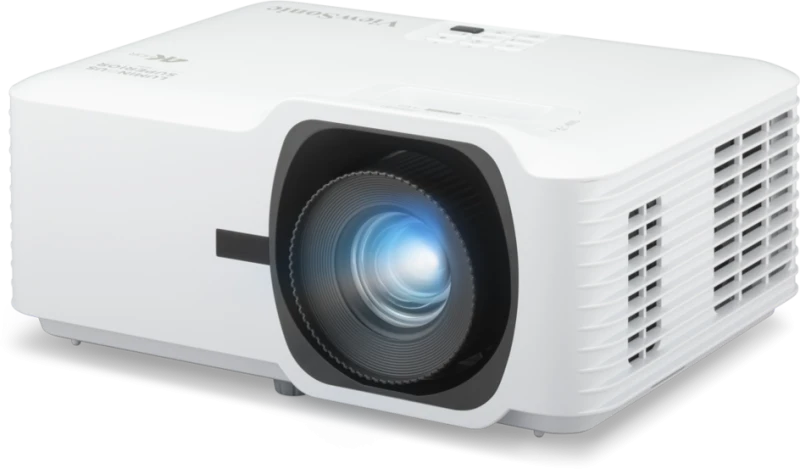
ViewSonic LSD500-4K: Native 4K, 5,000 ANSI Lumens, Zero Lamp Changes
ViewSonic has added a new installation projector to its Luminous Superior Series, and it’s aimed squarely at the venues that live and die by uptime: auditoriums, classrooms, boardrooms, and public spaces that can’t afford to shut down for lamp changes. The LSD500-4K pairs native 4K UHD resolution with 5,000 ANSI lumens and a laser-phosphor light source rated for 30,000 hours — officially announced August 18, 2026.
Product Overview
Unlike the consumer and gaming projectors we’ve been covering this week — the JMGO IRIS Ultra Max and Soundcore Nebula X1S among them — the LSD500-4K isn’t chasing living-room appeal. It’s a commercial and institutional installation projector, and its entire design language reflects that: durability, low maintenance, and integration with existing IT infrastructure take priority over smart features or a sleek chassis.
Design
ViewSonic’s headline engineering claim is size: the LSD500-4K’s footprint is 32% smaller than the previous generation in this line, despite the brightness increase, thanks to a third-generation laser phosphor light source that ViewSonic says is 20% more efficient than its predecessor. For installers working in tight equipment closets or above-ceiling mounts, that’s a genuinely practical improvement, not just a marketing number.
Display Technology
At the core is a 0.65-inch Texas Instruments DMD chip using DLP technology — a proven, reliable choice for installation projectors where consistency over years of daily use matters more than chasing the latest laser architecture. ViewSonic pairs it with an IP6X-rated sealed optical engine, which keeps dust out of the light path entirely rather than relying on a replaceable filter — a detail that matters enormously in dusty environments like gymnasiums or industrial training spaces, where filter maintenance is often the single biggest recurring cost of projector ownership.
Brightness
5,000 ANSI lumens is the headline figure, and ANSI — unlike some of the CVIA or unlabeled lumens figures we’ve flagged as unreliable in past coverage — is a standardized, independently verifiable measurement. That’s a meaningful trust signal on a spec sheet, and it puts the LSD500-4K solidly in the range needed for rooms with ambient light, like conference rooms with windows or lecture halls that stay partially lit.
Resolution
True native 4K UHD (3840×2160) — not pixel-shifted or upscaled — delivered through the DLP chip, which matters for legibility-critical use cases like architectural plans, spreadsheets, or fine text in a classroom setting.
Contrast
ViewSonic and various retailers list contrast figures as high as 3,000,000:1, though as with most projector contrast specs, that reflects a dynamic (not native) measurement — treat it as a general indicator of dynamic range rather than a literal on/off ratio.
HDR
The LSD500-4K supports both HDR10 and HLG, which is a genuine value-add in this category — most pure installation projectors skip HDR entirely since it’s aimed at cinematic content rather than presentations. It’s a sign ViewSonic is positioning this model for hybrid use, including home theater and hospitality settings where HDR content is more likely.
Connectivity and Control
Dual HDMI 2.0 inputs with HDCP 2.3 support handle native 4K content, while RJ45 LAN and RS232 connectivity allow the projector to be managed centrally through enterprise AV control systems — a requirement for any institution running dozens of projectors across a campus or building. A 1.6x optical zoom and ±30° horizontal/vertical keystone correction give installers real flexibility in mounting position without sacrificing image quality through digital correction.
Special Features
- 360-degree projection and portrait mode — enabling creative and non-traditional installations, including projection mapping.
- Golf Mode — a dedicated color mode tuned to enhance blue and green tones, aimed at the growing golf simulator market.
- Up to 30,000 hours of lamp-free operation in eco mode, effectively eliminating the recurring maintenance cost that defines lamp-based projector ownership.
Projection Size and Throw
The LSD500-4K supports screens up to 300 inches, with a throw ratio in the 1.4–2.24:1 range depending on configuration — solidly in installation-projector territory rather than the near-wall UST category we’ve covered elsewhere this week.
Price and Availability
ViewSonic hasn’t published a global MSRP as of this writing, though early UK retail listings have appeared around £1,350 (approximately $1,700) — notably affordable for a native 4K laser installation projector with this feature set, if that pricing holds across markets.
Who Should Buy It
- Educational institutions and corporate AV teams managing multiple projectors who need centralized LAN control and minimal ongoing maintenance.
- Golf simulator operators and hospitality venues that specifically benefit from the Golf Mode and large-screen support.
- Anyone installing in dusty or heavy-use environments where the IP6X sealed optical engine will meaningfully extend service life.
Who Should Look Elsewhere
- Home theater buyers will find better value and smart features in consumer-focused laser projectors — see our buying guide for options built specifically for that use case.
- Gamers won’t find VRR, ALLM, or high-refresh-rate support here — this is not a gaming-oriented spec sheet.
Pros and Cons
Pros: True native 4K, verified ANSI-lumen brightness rating, genuinely low maintenance burden, strong connectivity and centralized control options, and a smaller footprint than the previous generation despite the brightness increase.
Cons: No global pricing confirmed yet, no smart platform or streaming built in (by design, for this category), and no gaming-focused features for anyone hoping to dual-purpose it for home entertainment.
Final Verdict
The LSD500-4K is a straightforward, well-executed installation projector rather than an attention-grabbing launch — and for the audience it’s built for, that’s exactly the point. Verified brightness, low maintenance, and smart-building integration matter far more in a lecture hall or boardroom than smart TV features ever will. We’ll update this piece once global pricing and availability are confirmed.
]]>