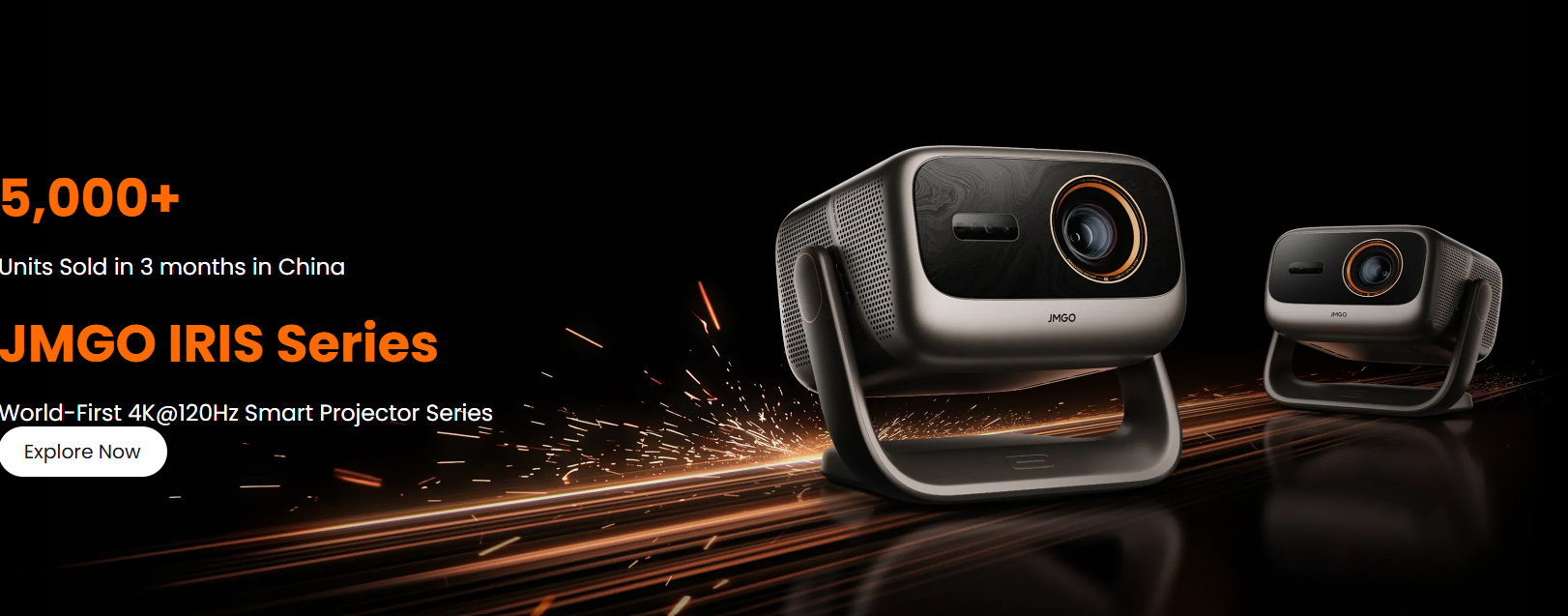
JMGO IRIS Ultra Max: The First 4K/120Hz Smart Projector, Reviewed on Paper
Editorial note: We’ve since published a fuller, updated breakdown of this launch, including expanded specs, a generation-over-generation comparison, and a head-to-head with XGIMI’s AURA 3 Max — read it here: JMGO IRIS Ultra Max: First 4K/120Hz All-in-One Projector.
JMGO has taken the wraps off the IRIS Ultra Max, and the company isn’t being shy about the claim attached to it: the world’s first 4K/120Hz smart projector, now available outside China. It pairs that headline refresh rate with a new dual-iris contrast system, a 6,500 ISO lumen triple-laser engine, and a full gaming feature set — VRR, ALLM, and Dolby Vision at 4K/120Hz. Preorders are open now at $2,999 (down from a $3,499 MSRP), with shipping starting October 19.
This lands the same week as several other 4K/120Hz projector stories we’ve been covering — including AWOL Vision’s LuxVision UST projector, which claims the same refresh rate in an ultra-short-throw form factor. JMGO’s approach is a genuinely different one, and worth understanding on its own terms.
Product Overview
The IRIS Ultra Max is positioned as an all-in-one smart projector — a Google TV device with a built-in triple-laser engine, not a body-only unit for installers. JMGO frames the entire IRIS series around one number: 4K at 120Hz, from source content all the way to the screen, which the company is marketing as a first for the smart projector category rather than for projection technology broadly (dedicated home theater projectors like JVC’s D-ILA line have supported native 4K/120p for longer, but typically without a built-in smart platform or all-in-one design).
Display Technology and the Dual-Iris System
The name “IRIS” isn’t incidental. JMGO’s new dual-iris system places two separate physical apertures at different points along the internal optical path, rather than relying on a single iris the way most laser projectors do. The idea is more aggressive control over light scatter and brightness, and JMGO says it delivers a 10,000:1 native contrast ratio as a result — a meaningful jump for a category where washed-out blacks have historically been the biggest complaint.
Brightness
JMGO rates the IRIS Ultra Max at 6,500 ISO lumens from its triple-laser light engine. For context, that’s higher than the Soundcore Nebula X1S we covered this week (6,000 ANSI lumens), though ISO lumens and ANSI lumens aren’t directly comparable measurement standards, so treat that as a rough reference point rather than an apples-to-apples ranking.
Resolution and Refresh Rate
True 4K at 120Hz is the headline spec, and JMGO is explicit that this applies end-to-end — from the content pipeline through to the projected image, not just an input-accepting spec that gets downscaled internally. That’s a meaningfully higher bar than most competing all-in-one projectors, most of which top out at 4K/60Hz.
Gaming Features
This is where the IRIS Ultra Max is clearly aimed. It supports VRR (Variable Refresh Rate) and ALLM (Auto Low Latency Mode) alongside its 4K/120Hz core, plus Dolby Vision HDR support even at the full 120Hz refresh — a combination that’s rare even among dedicated gaming monitors, let alone projectors. If JMGO’s numbers hold up under independent testing, this positions the IRIS Ultra Max as one of the most console- and PC-gaming-ready projectors currently shipping.
HDR
Dolby Vision support is confirmed at the full 4K/120Hz refresh rate — notably, JMGO isn’t restricting HDR to a lower-refresh mode the way some competitors do, which would otherwise force gamers to choose between HDR color and motion smoothness.
Operating System
Google TV is built in, consistent with the rest of JMGO’s current lineup, giving direct access to streaming apps and Google Assistant without needing an external streaming device.
Price and Availability
The IRIS Ultra Max carries a $3,499 MSRP, with preorders currently discounted to $2,999. Shipping is scheduled to begin October 19, 2026. It’s already listed as available outside China, following what JMGO says was strong initial sales in its home market.
How It Fits Against the Competition
| Spec | JMGO IRIS Ultra Max | Soundcore Nebula X1S | AWOL Vision LuxVision (UST) |
|---|---|---|---|
| Refresh rate at 4K | 120Hz | 60Hz | 120Hz |
| Brightness | 6,500 ISO lumens | 6,000 ANSI lumens | ~5,500 ISO lumens (unconfirmed) |
| Contrast approach | Dual-iris, 10,000:1 native | 6-blade iris, 56,000:1 dynamic (Dolby Vision) | 7-level dynamic iris + EBL |
| Gaming features | VRR, ALLM, Dolby Vision @ 120Hz | 4K/60Hz, <19ms latency | VRR, ALLM, 1ms claimed |
| Form factor | All-in-one lifestyle projector | All-in-one lifestyle/outdoor | Ultra short throw, fixed installation |
| Price | $3,499 ($2,999 preorder) | Not yet listed | Not yet announced |
For more on JMGO’s recent history, including a 2025 brightness-labeling correction across its N1 Ultra, N1 Pro, and U2 models, see our JMGO brightness correction explainer — worth keeping in mind as a data point when weighing manufacturer-claimed lumen figures against independent testing once reviews land.
Who Should Buy It
- Console and PC gamers who want a genuinely big-screen setup without sacrificing VRR, ALLM, or HDR at high refresh rates.
- Sports viewers who want smooth 120Hz motion handling for fast-moving content.
- Buyers who don’t need an ultra-short-throw form factor and are fine with standard projector placement distances.
Who Should Wait for Reviews
- Brightness- and color-sensitive buyers. JMGO’s own N3 Ultimate has drawn criticism in early press coverage for color distortion at peak brightness — worth watching for in IRIS Ultra Max reviews before buying at launch pricing.
- Anyone burned by previous JMGO brightness-labeling issues should wait for independently measured lumen figures rather than relying on the manufacturer’s rating alone.
Pros and Cons
Pros: Genuine 4K/120Hz with Dolby Vision intact, strong claimed brightness, a novel dual-iris contrast approach, and a full gaming feature set in an all-in-one, no-installation-required package.
Cons: Unverified brightness and contrast claims pending independent review, JMGO’s history of brightness-labeling corrections warrants some caution, and early impressions of the related N3 Ultimate flagged color distortion at peak brightness as a concern worth watching for here too.
Market Impact
The IRIS Ultra Max lands right as 4K/120Hz becomes a genuine battleground across the projector industry rather than a niche home-theater feature — AWOL Vision, JMGO, and others are all pushing high-refresh 4K into markedly different form factors (fixed UST installs versus all-in-one lifestyle projectors) within the same launch window. That convergence suggests 120Hz support is quickly becoming a baseline expectation for flagship projectors rather than a differentiator, much the way it did for TVs and monitors a few years earlier.
Frequently Asked Questions
Is the JMGO IRIS Ultra Max available now?
It’s open for preorder at $2,999, with shipping starting October 19, 2026.
Does it support Dolby Vision at 120Hz?
Yes — JMGO confirms Dolby Vision HDR support at the full 4K/120Hz refresh rate, without restricting HDR to a lower-refresh mode.
How does the dual-iris system work?
It places two separate physical apertures at different points in the optical path to control light scatter and brightness more aggressively than a single-iris design, which JMGO says delivers a 10,000:1 native contrast ratio.
Is 6,500 ISO lumens independently verified?
Not yet. It’s JMGO’s own manufacturer rating; independent measurement will need to wait for third-party reviews.
Final Verdict
On paper, the IRIS Ultra Max is one of the most aggressive gaming-focused projector launches of 2026 — a genuinely rare combination of 4K, 120Hz, VRR, ALLM, and Dolby Vision in a no-installation, all-in-one box. Given JMGO’s past brightness-labeling issues and early color-accuracy concerns with its N3 Ultimate, though, this is a launch worth waiting on independent reviews for before committing at full price — the preorder discount helps offset that risk if you’re willing to be an early adopter.
]]>