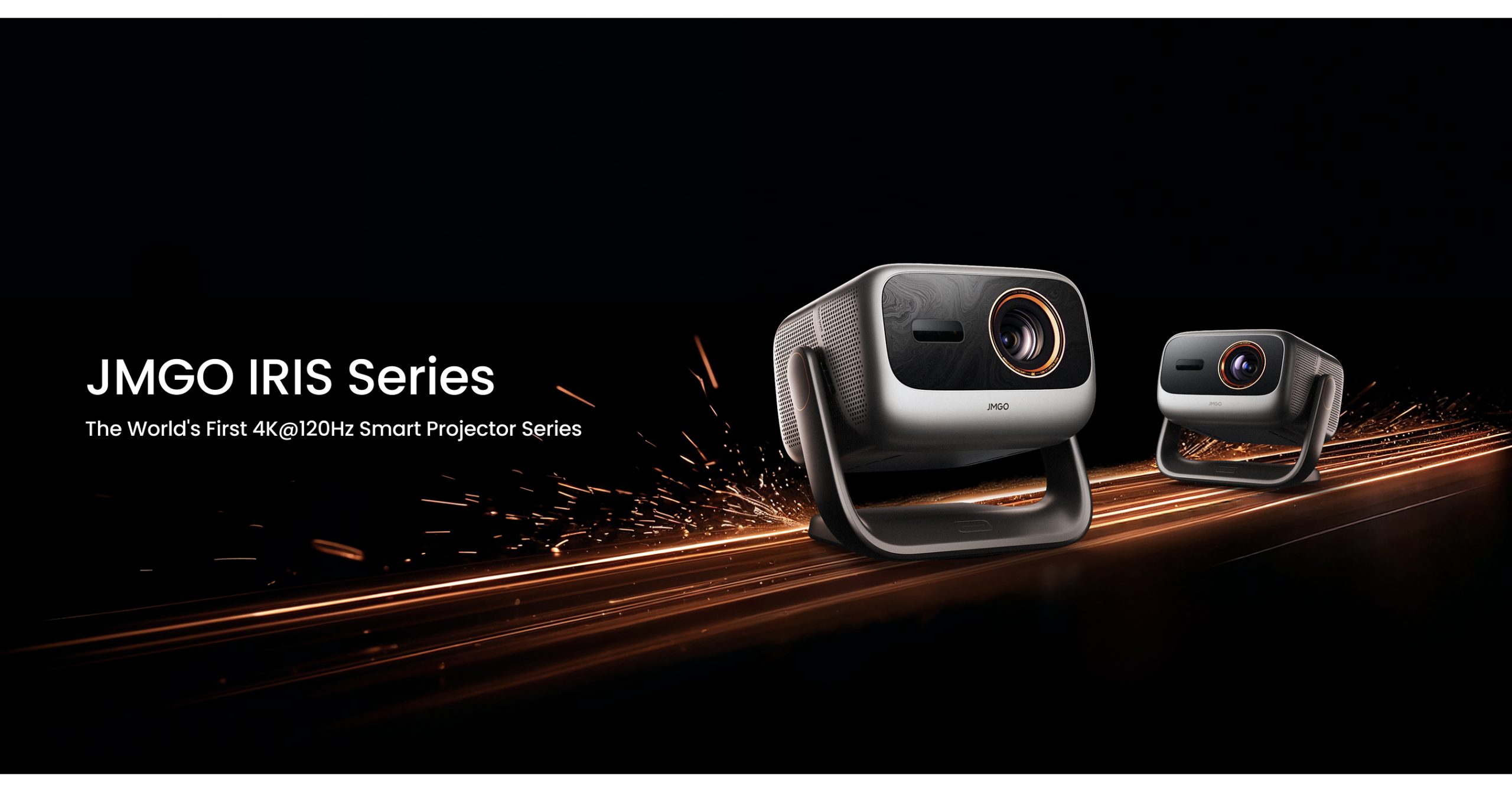
JMGO IRIS Ultra Max: First 4K 120Hz All-in-One Projector
Last updated: September 8, 2026
A week after XGIMI staked its claim to “first 4K/120Hz UST projector,” JMGO showed up at IFA 2026 with a different but related pitch: the first all-in-one, movable smart projector to run true 4K resolution at a full 120Hz refresh rate, from the HDMI input all the way through to the image on your wall. The flagship of the new lineup is the JMGO IRIS Ultra Max, joined by a more affordable sibling, the JMGO IRIS Ultra.
It’s worth pausing on that distinction, because it matters for anyone comparing this to XGIMI’s recent launch. XGIMI’s AURA 3 Max is an ultra-short-throw (UST) projector — a fixed unit designed to sit permanently on a media console a few inches from your wall or screen. JMGO’s IRIS Ultra Max is a portable, repositionable lifestyle projector with an AI-powered gimbal that can swivel and tilt to project onto almost any surface in a room, then be picked up and moved somewhere else entirely. Both are chasing the same headline spec — native 4K at 120Hz — but they’re built for genuinely different use cases, and it’s entirely possible for both companies’ “world’s first” claims to be true within their respective projector categories.
Below, we’ll walk through everything currently known about the IRIS Ultra Max and IRIS Ultra: design and placement flexibility, display technology, brightness, gaming performance, audio, connectivity, pricing, and how the pair stacks up against JMGO’s own previous flagship and against XGIMI’s competing launch.
Product Overview
The JMGO IRIS Series consists of two models sharing the same core optical and processing platform:
- JMGO IRIS Ultra Max — the flagship, rated at up to 6,500 ISO lumens and 10,000:1 native contrast, with a full AI-powered gimbal
- JMGO IRIS Ultra — the value-focused sibling, rated at 4,500 ISO lumens and 7,000:1 native contrast, without the full gimbal system
JMGO says the underlying 4K/120Hz technology isn’t brand new — a China-market version reportedly sold more than 5,000 units in its first three months after launching there in May 2026, which the company is citing as the reason it decided to bring the platform to global markets under the IRIS name.
Design: Built to Move, Not Mounted
Where UST projectors lean into permanence — a fixed spot on a console, a matched screen, a set-it-and-forget-it installation — the IRIS Ultra Max leans hard into flexibility. It’s designed to be picked up, carried to a different room, or repositioned on the fly, and JMGO has built a fairly elaborate optical system to support that.
The core of this is what JMGO calls a 3-in-1 optical system, combining:
- 0.88–1.7:1 optical zoom — lets the projected image grow or shrink without digital scaling, which normally softens detail
- Four-way lens shift (vertical ±130%, horizontal ±53%) — physically shifts the lens elements to reposition the image without moving the projector body or introducing keystone distortion
- AI-powered gimbal (360° pan, 150° tilt) — motorized aiming that can automatically point the image at a wall, ceiling, or screen from an off-center or angled placement
Why This Matters
Digital keystone correction — the software trick most projectors use to square up an image projected at an angle — works by cropping and stretching the picture, which throws away resolution and can introduce softness at the edges. A physical lens-shift and gimbal system avoids that trade-off entirely, since it’s aiming the actual optics rather than distorting the output afterward. JMGO backs this up with AI Screen Fitting, which automatically detects a screen or flat surface and aligns to it, and AI Spatial Image Memory, which can remember specific projection setups (position, size, even which app was open) for different rooms or walls, so switching locations doesn’t mean recalibrating from scratch every time.
The IRIS Ultra keeps the optical zoom and four-way lens shift but drops the full motorized gimbal, which is the clearest hardware distinction between the two models beyond brightness and contrast.
Display Technology: MALC 6.0 Triple Laser and a 15-Blade Dual Iris
At the heart of both IRIS models is JMGO’s next-generation MALC 6.0 Triple-Laser Engine — a light source using separate red, green, and blue lasers to produce color, rather than a single laser diode paired with a phosphor wheel. This generally translates into more accurate, saturated color across a wider range of brightness levels than phosphor-based laser or LED light sources.
JMGO pairs that laser engine with a Dual-Iris optical system, and the specific detail worth noting here is the blade count: JMGO’s design uses 15 blades (a 6-blade primary iris plus a 9-blade secondary iris), which the company says improves stray-light suppression by roughly 11.34% compared with a more common 12-blade (6+6) dual-iris configuration. More blades generally means a more precisely circular aperture opening, which reduces light leakage around the edges of the iris and helps produce cleaner black levels.
Explaining the Jargon
A dual-iris system uses two adjustable apertures in the light path to control exactly how much light passes through at any given moment — similar in concept to the iris in a camera lens. This lets a projector dim itself during dark scenes (for deeper blacks) and open back up during bright scenes (for peak highlights), rather than being locked to one fixed brightness level throughout a film.
The result, per JMGO’s own figures, is a native contrast ratio of up to 10,000:1 on the IRIS Ultra Max and 7,000:1 on the IRIS Ultra — both models also offer six manual iris adjustment levels so the projector can be tuned to a specific room’s ambient light and the type of content being watched.
Image processing is handled by JMGO’s AI DBL (Dynamic Black Level) technology, which the company says works zone-by-zone and frame-by-frame to pull out shadow detail in dark scenes while keeping skin tones and facial texture looking natural — a common failure point for projectors that push contrast too aggressively and end up crushing detail in dark clothing or hair.
Brightness: Up to 6,500 ISO Lumens
The IRIS Ultra Max is rated at up to 6,500 ISO lumens, with the IRIS Ultra coming in at 4,500 ISO lumens. ISO lumens is the standardized brightness measurement most manufacturers have converged on in recent years, intended to make cross-brand comparisons more reliable than older, less consistent “ANSI lumens” marketing figures.
At 6,500 ISO lumens, the IRIS Ultra Max is brighter on paper than most portable or lifestyle-category projectors currently on the market, and JMGO is explicitly marketing it as usable “in the bright environment, no dark room required.” Combined with the 10,000:1 native contrast figure, that’s a genuinely strong pairing — brightness alone tends to wash out an image if contrast can’t keep pace, so the two specs matter together rather than in isolation.
Resolution and the 4K/120Hz Claim
This is the feature both JMGO and XGIMI are racing to claim first, so it’s worth being precise about what JMGO says is happening under the hood. The IRIS Series uses dual DLPC8-series display controllers working in tandem with JMGO’s own HyperPulse Actuator, which physically shifts the DLP micromirror array 480 times per second. According to JMGO, this is what allows the projector to display genuine 3840×2160 pixel detail at a full 120 frames per second, rather than the more common workaround of dropping to 1080p or 60Hz to hit higher frame rates.
JMGO is positioning this specifically as an advance for single-chip DLP projection, where a single digital micromirror device (DMD) chip has to generate the full color image by cycling through red, green, and blue extremely quickly (a technique called XPR, or pixel-shifting). Historically, that cycling speed has been the bottleneck preventing single-chip DLP projectors from hitting both 4K resolution and 120Hz simultaneously — JMGO’s claim is that the new controller-and-actuator combination clears that bottleneck.
The full 4K/120Hz signal path runs over HDMI 2.1, with both HDMI inputs on the IRIS Ultra Max supporting the format and one additionally supporting eARC for passing audio out to an AV receiver or soundbar with minimal loss.
Contrast, HDR, and Color
Beyond the headline 10,000:1 native contrast figure, the IRIS Series supports:
- Dolby Vision — including, notably, Dolby Vision at full 4K/120Hz, which JMGO is calling a world first for the format
- Dolby Audio
- 3D playback, with two pairs of 3D glasses included in the box
- Hardware-level Anti-RBE (Anti-Rainbow Effect) processing
Explaining the Jargon
- Dolby Vision is a dynamic HDR format that adjusts brightness and color on a scene-by-scene (or frame-by-frame) basis rather than using one fixed setting for an entire film, which typically produces more accurate highlights and shadow detail than static HDR formats.
- Anti-RBE (Anti-Rainbow Effect) processing addresses a visual artifact specific to single-chip DLP projectors, where fast-moving high-contrast edges can occasionally show brief flashes of red, green, or blue fringing. JMGO says its hardware-level approach reduces this without adding operating noise, which is sometimes a trade-off with software-based fixes.
Color coverage is rated at 110% of the BT.2020 color gamut with a claimed color accuracy of roughly ΔE 0.7 — a lower Delta-E number indicates color that’s closer to the mathematically “correct” reference value, and figures below 1.0 are generally considered excellent, though this is a manufacturer-supplied figure pending independent verification.
Gaming Features
The IRIS Series is squarely aimed at gamers who want a genuinely large image without giving up frame rate or resolution. Key gaming specs include:
- Variable Refresh Rate (VRR) — matches the projector’s refresh rate to a connected GPU’s output to reduce screen tearing
- Auto Low Latency Mode (ALLM) — automatically switches to a low-latency picture mode when a console or gaming PC is detected
- 4K gaming at up to 120fps over HDMI 2.1
- Dolby Vision Gaming support at full 4K/120Hz, per JMGO’s claims
For anyone running a current-generation console or a gaming PC that can push 4K/120 signals, this puts the IRIS Ultra Max in a similar performance bracket to a high-end gaming TV — just projected at a size no TV panel can practically match.
Operating System and Smart Platform
The IRIS Series runs Google TV built in, with native access to Netflix, Prime Video, and the rest of the standard app ecosystem without needing an external streaming stick. JMGO’s marketing frames this as putting your entertainment on “a massive 300-inch screen” — a maximum figure that should be read as an upper bound achievable under ideal conditions (a large, flat, dark-capable wall or screen and sufficient throw distance) rather than a typical living-room result.
Audio
Audio is a more modest part of the IRIS Ultra Max’s pitch than its picture quality. The projector houses a built-in stereo speaker system rated at roughly 12.5 watts per speaker, for about 25 watts total output — enough for casual viewing, YouTube, news, or spontaneous movie nights, but clearly secondary to JMGO’s optical and processing investment. For serious home theater use, the eARC-enabled HDMI port allows the projector to pass audio through to an external AV receiver or soundbar with minimal loss, which is realistically how most buyers pairing this with a proper home theater setup will use it.
Connectivity: WiFi, USB, HDMI
- HDMI: Two HDMI 2.1 ports, both supporting the full 4K/120Hz signal path; one additionally supports eARC for external audio output
- USB: One USB 3.0 port for local media playback or connecting storage devices
- WiFi: Built-in wireless networking for Google TV and streaming connectivity
- Bluetooth: JMGO’s product materials do not explicitly detail Bluetooth specifications for the IRIS Series at the time of writing; we’ll update this section once confirmed
Throw Ratio, Placement, and Projection Size
Unlike a UST projector, which is defined by a single fixed throw ratio designed for close-range placement, the IRIS Ultra Max’s 0.88–1.7:1 optical zoom range gives it flexibility across a range of distances from the wall — closer to a traditional short-throw or standard-throw projector’s placement logic than a UST model’s near-contact setup. Combined with the four-way lens shift and 360°/150° AI gimbal, the practical result is that the IRIS Ultra Max can be placed on a shelf, coffee table, or side console at an angle and still produce a squared-up image without physically repositioning the unit.
JMGO’s official noise rating for the IRIS Series is 26dB, which is quiet enough to sit in the same room as a conversation without becoming a distraction — a meaningful consideration for a projector explicitly designed to be moved between living spaces rather than tucked away behind furniture.
Comparison With the Previous Generation (JMGO N3 Ultra Max)
JMGO’s prior flagship, the N3 Ultra Max, launched globally in 2025 and established the template the IRIS Series builds on: triple laser light source, Google TV, native Netflix, autofocus, and an AI electric gimbal. The IRIS Ultra Max keeps that same design philosophy but pushes every core spec meaningfully further:
| Spec | JMGO N3 Ultra Max (2025) | JMGO IRIS Ultra Max (2026) |
|---|---|---|
| Max refresh rate | 4K/60Hz | True 4K/120Hz |
| Light source | Triple Laser | MALC 6.0 Triple Laser |
| Native contrast | Not officially rated at this level | Up to 10,000:1 |
| Dual-iris design | Not featured | 15-blade (6+9) |
| Color gamut | Not officially specified at this level | 110% BT.2020 |
| Placement system | AI electric gimbal, autofocus | 3-in-1 system: zoom + lens shift + AI gimbal |
| Smart platform | Google TV, native Netflix | Google TV, native Netflix/Prime Video |
| Noise level | Not officially disclosed | 26dB |
The jump from 4K/60Hz to genuine 4K/120Hz is the single biggest architectural leap between generations, enabled by the new dual-DLPC-controller-plus-HyperPulse-Actuator combination that wasn’t part of the N3 Ultra Max’s design.
Comparison With Competitors
The most relevant comparison right now isn’t a like-for-like rival in JMGO’s own category — it’s XGIMI’s AURA 3 Max, announced just days earlier and chasing a similar headline spec through a completely different form factor.
| Spec | JMGO IRIS Ultra Max | XGIMI AURA 3 Max |
|---|---|---|
| Category | All-in-one / portable lifestyle projector | Ultra-short-throw (UST) laser TV |
| Placement | Movable, AI gimbal + lens shift, any surface | Fixed, ~8 inches from wall |
| Brightness | Up to 6,500 ISO lumens | Up to 5,700 ISO lumens |
| Native contrast | 10,000:1 | 8,000:1 |
| 4K/120Hz support | Yes, native, HDMI 2.1 | Yes, native, HDMI 2.1 |
| Dolby Vision at 4K/120Hz | Yes (claimed world first) | Dolby Vision supported; 4K/120 gaming pairing not specifically claimed as a format first |
| Built-in audio | ~25W stereo | 80W Harman Kardon, Dolby Atmos |
| Smart platform | Google TV | Google TV |
| Early-bird price | $2,999 (Ultra Max) | $2,199–$2,399 (Kickstarter pricing) |
The honest takeaway here is that these two “world’s first 4K/120Hz” projectors aren’t really competing head-to-head for the same buyer. XGIMI’s AURA 3 Max is a home-theater centerpiece with dramatically stronger built-in audio and a screen-filling UST throw designed for one permanent spot in the room. JMGO’s IRIS Ultra Max is a flexible, movable unit that trades some audio power and a fixed large-screen throw for placement freedom and a brighter, higher-contrast image on paper — at a meaningfully higher early-bird price. Buyers deciding between the two should weigh whether they want a fixed home-theater setup or a projector they can genuinely move from room to room. See our full roundup of every confirmed 4K/120Hz projector for the complete picture. For a look at how the IRIS Ultra Max also stacks up against the Soundcore Nebula X1S and AWOL Vision’s LuxVision, see our original launch-day breakdown.
Availability and Pricing
JMGO has opened pre-orders directly rather than routing through Kickstarter:
- Pre-orders opened September 4, 2026 at JMGO’s official global and EU webstores
- Early-bird pricing: JMGO IRIS Ultra Max at $2,999 (down from an MSRP of $3,499); JMGO IRIS Ultra at $1,899 (down from an MSRP of $2,399)
- Shipping begins October 19, 2026
- Pre-order bundles include a floor stand or ceiling mount (buyer’s choice), two pairs of 3D glasses, and an 8K-rated HDMI cable, plus a discount on JMGO’s optional Photon Anti-Speckle Screen (50% off for IRIS Ultra Max buyers, 30% off for IRIS Ultra buyers) during the pre-order window
Who Should Buy the IRIS Ultra Max?
Good fit for:
- Buyers who want a genuinely portable big-screen setup — living room tonight, bedroom or patio tomorrow — without sacrificing 4K/120Hz performance
- Gamers who want the brightest, highest-contrast numbers currently claimed in this projector category
- Renters or anyone who can’t permanently mount or install a fixed UST projector and screen combination
- Buyers who plan to pair the projector with an existing soundbar or AV receiver via eARC rather than relying on built-in speakers
Maybe wait if:
- You want a fixed home-theater centerpiece with strong built-in audio out of the box — the AURA 3 Max’s 80W Harman Kardon system is considerably more capable than the IRIS Ultra Max’s roughly 25W stereo setup
- You’re budget-conscious — the IRIS Ultra Max’s $2,999 early-bird price sits above XGIMI’s discounted AURA 3 Max pricing
- You want independently verified performance numbers before committing, since contrast, color accuracy, and the Dolby Vision 4K/120Hz claim are all manufacturer-supplied at this stage
Pros and Cons
Pros:
- Claims to be the first all-in-one/portable projector with true native 4K at 120Hz
- Class-leading brightness at up to 6,500 ISO lumens for this projector category
- 10,000:1 native contrast via a refined 15-blade dual-iris system
- Genuinely flexible placement: optical zoom, four-way lens shift, and a 360°/150° AI gimbal
- Quiet operation at a rated 26dB
- Comprehensive HDR support including Dolby Vision at full 4K/120Hz
- Generous pre-order bundle (mount, 3D glasses, HDMI cable, screen discount)
Cons:
- Built-in audio (~25W stereo) is noticeably weaker than rival UST projectors with dedicated audio partnerships
- Higher early-bird price than some directly competing 4K/120Hz launches
- Key claims (contrast, color accuracy, Dolby Vision 4K/120Hz world-first status) are unverified by independent reviewers as of this writing
- Bluetooth specifications are not yet clearly documented in JMGO’s official materials
- As a movable, non-UST design, it won’t match a UST projector’s simplicity for someone who only ever wants one permanent giant-screen setup
Market Impact
JMGO’s IRIS Series lands at a moment when the phrase “4K/120Hz” is suddenly showing up across two different projector categories within the same week — UST laser TVs and portable lifestyle projectors — which is a strong signal that high-refresh 4K decoding hardware has crossed a cost and complexity threshold that makes it viable across price tiers and form factors, not just in flagship home-theater installations. If JMGO’s claims hold up, expect other lifestyle-projector brands (Anker’s Soundcore Nebula line, Samsung’s portable lineup, and others) to follow with their own high-refresh 4K offerings within the next product cycle, similar to how UST brands are likely to respond to XGIMI’s AURA 3 Series.
Predicted Future Availability
Based on the disclosed timeline, here’s the expected rollout:
- Now: Pre-orders open at JMGO’s global and EU webstores with early-bird pricing
- October 19, 2026: Shipping begins for pre-order customers
- Post-launch: Broader retail availability likely through Amazon and other major electronics retailers, following the pattern of JMGO’s previous global launches
Frequently Asked Questions
Is the JMGO IRIS Ultra Max really the first 4K/120Hz all-in-one projector?
Based on JMGO’s published specifications, it claims to be the first all-in-one, portable smart projector to display native 4K resolution at a full 120Hz refresh rate, using a dual-DLPC-controller design paired with JMGO’s HyperPulse Actuator. This is a different projector category from XGIMI’s AURA 3 Max, which makes a similar claim specifically within the ultra-short-throw (UST) category.
How much does the JMGO IRIS Ultra Max cost?
Early-bird pricing is $2,999 for the IRIS Ultra Max (down from an MSRP of $3,499) and $1,899 for the IRIS Ultra (down from an MSRP of $2,399). Pre-orders opened September 4, 2026, with shipping expected to begin October 19, 2026.
What’s the difference between the IRIS Ultra Max and IRIS Ultra?
Both share the same MALC 6.0 triple-laser engine, 4K/120Hz support, and core smart platform. The IRIS Ultra Max is brighter (6,500 vs. 4,500 ISO lumens), has higher native contrast (10,000:1 vs. 7,000:1), and includes the full AI-powered 360°/150° gimbal, while the IRIS Ultra keeps the optical zoom and lens-shift system but drops the motorized gimbal.
Does the IRIS Ultra Max support Dolby Vision?
Yes, including at full 4K resolution and 120Hz refresh rate — a combination JMGO is marketing as a world first for the format. It also supports Dolby Audio and hardware-level Anti-RBE processing to reduce rainbow artifacts.
How does the JMGO IRIS Ultra Max compare to the XGIMI AURA 3 Max?
Both claim “world’s first” 4K/120Hz status within their respective categories — JMGO within all-in-one/portable projectors, XGIMI within UST laser TVs. The IRIS Ultra Max is brighter on paper and more flexible in placement, while the AURA 3 Max offers substantially stronger built-in audio (80W Harman Kardon vs. roughly 25W) and a screen-filling UST throw built for one permanent setup. They serve somewhat different buyers rather than competing directly.
When will the JMGO IRIS Series ship?
Pre-orders opened September 4, 2026, with shipping expected to begin October 19, 2026, for early-bird customers.
Conclusion
The JMGO IRIS Ultra Max is a genuinely notable launch for anyone who’s wanted 4K/120Hz gaming and home-theater performance without committing to a permanently mounted setup. JMGO’s engineering claim — true native 4K detail at a full 120 frames per second from a single-chip DLP design — would have sounded implausible even a generation or two ago, and the surrounding spec sheet (6,500 lumens, 10,000:1 native contrast, a genuinely flexible AI gimbal system) backs up the ambition. The trade-offs are real: built-in audio is modest, and the early-bird price sits above some competing launches. But for buyers who value portability as much as picture quality, the IRIS Ultra Max is shaping up to be one of the more interesting projector releases of the back half of 2026. We’ll update this article with hands-on testing and independently verified performance figures as review units become available ahead of the October 19 shipping date.