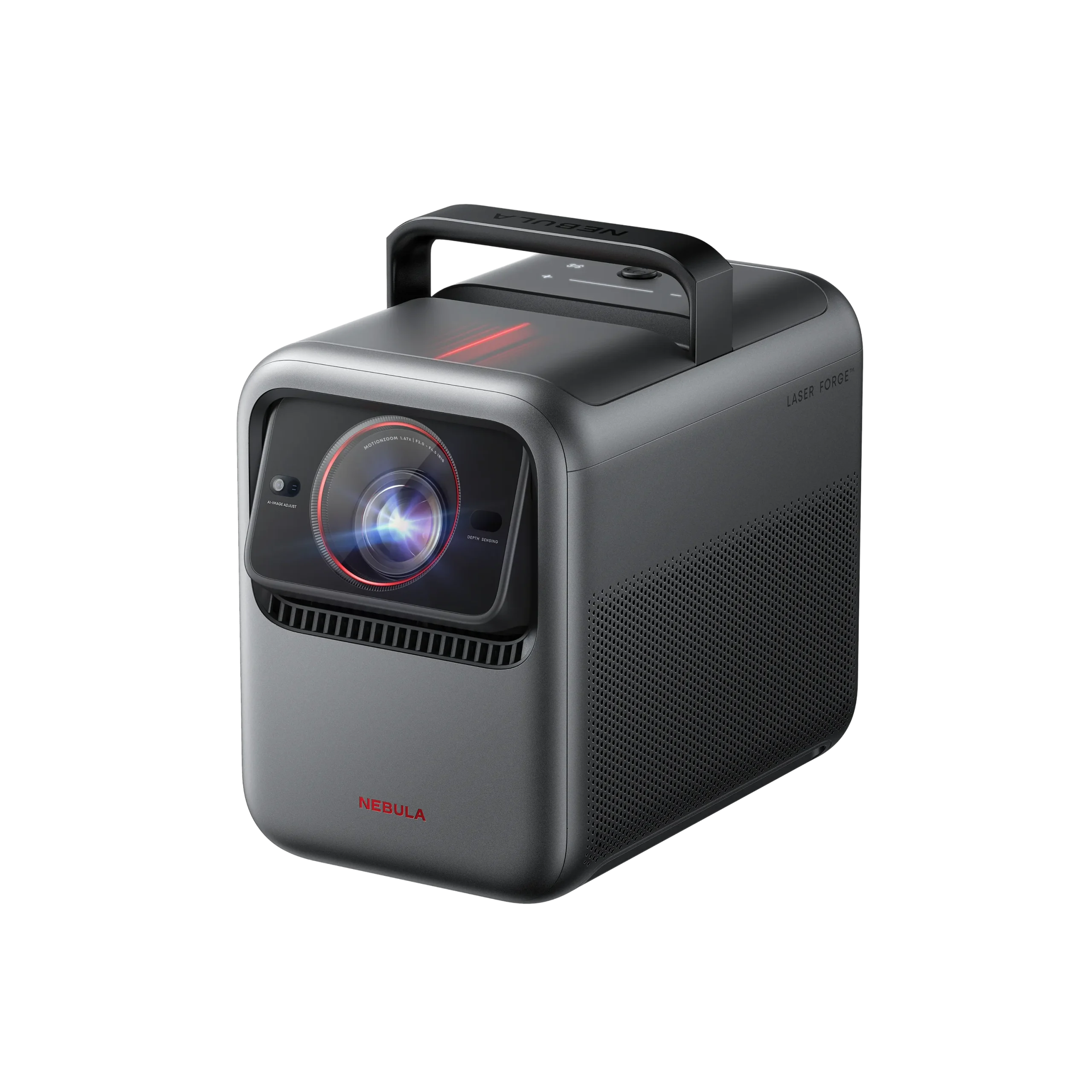
Soundcore Nebula X1S: 6,000-Lumen 4K Projector Built for Daylight Viewing
Anker’s Soundcore division has just given its Nebula X1 line its biggest brightness jump yet. The new Nebula X1S swaps in a four-lamp triple-laser engine to push output from 3,500 up to 6,000 ANSI lumens — enough, Soundcore says, to watch content with the curtains open. It’s part of a genuinely busy last week of August for projector announcements; see our roundup of what else landed alongside it, including the newly confirmed AWOL Vision LuxVision and the CEDIA Expo lineup we previewed here.
Product Overview
The Nebula X1S isn’t a ground-up redesign — it’s Soundcore taking its well-reviewed X1 platform and addressing its single biggest limitation: daytime usability. Projectors have always had an asterisk next to them for anyone who wants to watch sports or stream a movie mid-afternoon with light in the room. Soundcore’s answer here is simply more raw brightness, backed by a cooling system built to handle the extra heat without turning the room into a wind tunnel.
Design
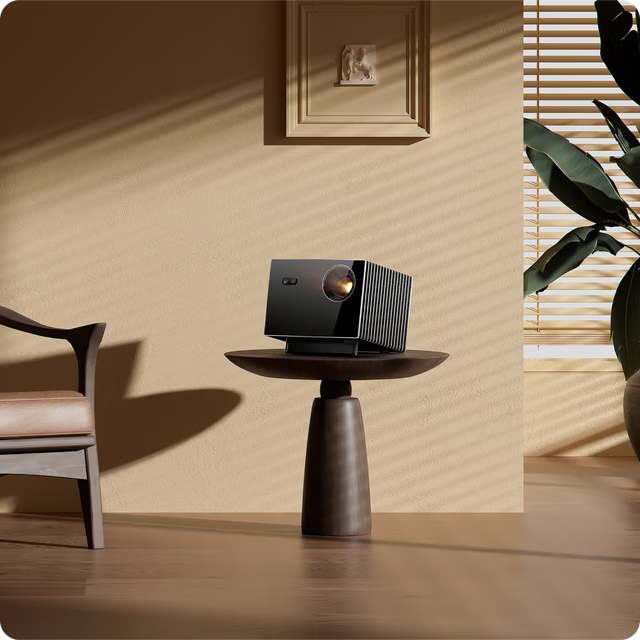
The X1S keeps the X1’s flexible placement design: it can sit on a stand, a table, or the floor, with 25 degrees of tilt available for angling the image without needing a separate mount. That matters for the backyard and patio use case Soundcore is clearly building toward — this is being marketed as a lifestyle and outdoor projector as much as a living-room one.
Display Technology and Optical Engine
Soundcore calls the light engine the “4K Triple Laser Engine with LaserForge,” and the headline change is mechanical: a fourth laser stack has been added to the existing three-lamp RGB array. That’s a brute-force approach to brightness compared to the more exotic dynamic-iris or dual-controller tricks we’re seeing on some 2026 UST flagships, but it’s a straightforward one that’s easy to verify and doesn’t rely on processing tricks.
Brightness
This is the X1S’s entire reason for existing. It’s rated at 6,000 ANSI lumens in Peak Output (“Conference”) Mode — a 71% jump over the original X1’s 3,500 ANSI lumens — with a 3,000 ANSI lumen “Standard” mode for everyday use and a separate “Vivid” mode tuned for color accuracy over raw brightness. Soundcore’s own comparison puts this in useful context: pick Standard for controlled-light movie nights, and reach for Conference mode specifically when ambient light would otherwise wash out the image.
Resolution
4K UHD, unchanged from the X1, with support for screens up to 200 inches from a projection distance of 13–22 feet using the built-in optical zoom.
Contrast
Soundcore lists a 5,000:1 native contrast ratio in SDR, rising to as much as 56,000:1 dynamic contrast when displaying Dolby Vision content. That dynamic swing comes from a 6-blade iris with a variable f/2.0–f/4.5 aperture — the same iris design used on the original X1, carried over unchanged here.
HDR
The X1S supports Dolby Vision natively, which is still relatively rare in the lifestyle/portable projector segment where HDR10 is more common. Color coverage is rated at 106% of the Rec.2020 gamut in Vivid mode — close to, though not quite matching, the more premium Nebula X1 Pro.
Gaming Features
The X1S supports 4K/60Hz gaming over HDMI 2.1 with input latency reported below 19ms — respectable for a lifestyle projector, though well behind the sub-5ms figures some dedicated gaming projectors and UST flagships are now claiming (AWOL Vision’s newly revealed LuxVision, for comparison, claims 1ms at 4K/120Hz). If low-latency competitive gaming is the priority, this isn’t the model to chase; if it’s casual couch co-op or watching a match on a big screen, 19ms is a non-issue.
Operating System
Google TV is built in, with native Netflix integration and access to the platform’s full app catalog — a meaningful upgrade path over projectors that rely on casting from a phone or a separate streaming stick.
Audio
Dual 40W speakers are built into the chassis, with the option to add wireless satellite speakers for a 4.1.2 surround setup — a nod to the projector’s positioning as a genuine home-theater-in-a-box rather than a screen-only device.
Connectivity, Power, and Noise
Soundcore’s headline engineering claim here is thermal: the X1S uses an internal liquid cooling system paired with a single rear fan, which the company says improves heat dissipation by 15% while shrinking the footprint by 30% compared to fan-only competitors at similar brightness levels. The payoff is a claimed 28dB noise level at 1 meter in Standard mode — roughly whisper-quiet — though Conference mode’s 6,000-lumen output understandably pushes noise higher, to around 43dB.
Throw Ratio and Projection Size
The optical zoom covers a 13–22 foot throw distance for screens up to 200 inches, giving it meaningfully more placement flexibility than fixed-throw UST models, at the cost of the near-wall footprint UST buyers specifically want.
Comparison With the Original Nebula X1
| Spec | Nebula X1 (original) | Nebula X1S (new) |
|---|---|---|
| Brightness | 3,500 ANSI lumens | 6,000 ANSI lumens (Conference Mode) |
| Light engine | 3-lamp triple laser | 4-lamp triple laser |
| Resolution | 4K UHD | 4K UHD (unchanged) |
| HDR | Dolby Vision | Dolby Vision (unchanged) |
| Best fit | Controlled-light rooms | Daytime / bright-room / outdoor use |
Who Should Buy the Nebula X1S
- Outdoor and patio movie-night hosts who need brightness that survives dusk-to-dark transitions and stray porch light.
- Daytime sports watchers who don’t want to black out a room every time there’s a Saturday afternoon game.
- Existing X1 owners in bright rooms who found the original’s 3,500 lumens came up short.
Who Should Look Elsewhere
- Dedicated home theater buyers in fully light-controlled rooms won’t see much benefit from the extra brightness and might prefer the quieter, cheaper original X1.
- Serious gamers chasing minimal input lag should look at dedicated gaming-focused models instead.
- UST buyers who specifically want a near-wall footprint — the X1S needs 13+ feet of throw distance, unlike ultra-short-throw designs such as those we’ve covered from Hisense and AWOL Vision.
Pros and Cons
Pros: Genuinely daylight-usable brightness, Dolby Vision support that’s rare at this level, built-in Google TV, quiet operation at standard brightness, flexible placement.
Cons: 19ms input lag isn’t competitive-gaming territory, noise climbs noticeably in Conference mode, and the core platform (4K resolution, contrast hardware) is otherwise unchanged from the original X1.
Market Impact
The X1S lands in the same week as several higher-end UST announcements, and the contrast is useful: while brands like AWOL Vision and Hisense are chasing installation-flexibility features for fixed home theaters, Soundcore is making the opposite bet — that portability and raw daylight brightness are what a growing slice of buyers actually want. Both approaches are valid, and both are proof that the “projectors only work in dark rooms” complaint is quickly becoming outdated across the whole category.
Frequently Asked Questions
Is the Nebula X1S available to buy now?
Yes — Soundcore has officially launched the X1S; check Soundcore’s site for current regional pricing and availability.
How much brighter is the X1S than the original X1?
About 71% brighter at peak — 6,000 ANSI lumens versus 3,500 ANSI lumens on the X1.
Does the X1S support Dolby Vision?
Yes, natively, matching the original X1.
Is the X1S good for gaming?
It supports 4K/60Hz with under 19ms of input lag — fine for casual gaming, but not aimed at competitive players who need the lowest possible latency.
Final Verdict
The Nebula X1S is a focused, sensible update rather than a reinvention: same platform, one meaningful upgrade, aimed squarely at buyers whose rooms — or patios — never get properly dark. If that’s your actual viewing environment, the brightness jump alone justifies the upgrade over the original X1.
]]>