AWOL Vision LuxVision Officially Revealed: World’s First 4K 120Hz UST Projector With Optical Shift
AWOL Vision has pulled back the curtain — mostly — on its newest ultra short throw (UST) projector, and it isn’t a refresh of the Aetherion line. It’s an entirely new flagship called LuxVision, and the brand is calling it the world’s first 4K 120Hz UST projector with a feature it calls Optical Shift. Officially, the full reveal is scheduled for early September 2026 at CEDIA Expo and IFA Berlin, but AWOL Vision has already published a dedicated product page and briefed several outlets, so we have a clear picture of what’s coming.
We first flagged this launch in our earlier preview of AWOL Vision’s IFA Berlin 2026 plans, published before the company had confirmed a model name. Now that LuxVision has a name, a design language, and a fairly detailed feature list, it’s time for the full breakdown.
Product Overview
LuxVision slots in above AWOL Vision’s existing Aetherion Max and Aetherion Pro, both of which only started reaching Kickstarter backers in the past few weeks. That’s a notably fast follow-up — barely a season after Aetherion shipped, AWOL Vision is already positioning a new flagship above it. The move signals how aggressively the UST category is moving right now, with AWOL Vision, XGIMI, Hisense, and JMGO all racing to out-spec each other ahead of the autumn trade show season.
At its core, LuxVision is a triple-laser RGB ultra short throw projector built around Texas Instruments’ newer 0.47-inch DLP473TE DMD chip, paired with a dual DLPC8555 controller architecture. That controller pairing matters more than it sounds: driving a 4K image at 120Hz means pushing nearly a billion pixels per second through the DMD/XPR pixel-shifting system, and this generation of TI hardware is specifically built to handle that load without the chroma artifacts or judder that plagued earlier attempts at high-refresh 4K on DLP.
Design
AWOL Vision is leaning hard into design language this time. The company describes LuxVision’s cabinet as inspired by “the Parthenon’s architectural order,” translating classical column rhythm into a UST chassis — marketing language for a boxier, more sculptural cabinet than the rounded Aetherion series. Buyers will also be able to special-order custom color, material, and finish (CMF) options, which is a first for the brand and edges LuxVision toward the kind of furniture-grade presentation Samsung and LG have pushed with their Premiere and CineBeam UST lines.
Display Technology and Optical Engine
The RGB triple-laser light source is the headline optical component, and AWOL Vision says it enables coverage of 110% of the Rec.2020 color space — a wide gamut that, if it holds up in independent testing, would put LuxVision ahead of most single- or dual-laser UST projectors on color volume. The lens itself uses what AWOL calls a magnetron sputtering coating process, applied in a vacuum environment to reduce internal reflections and improve edge-to-edge uniformity. It’s the kind of manufacturing detail that rarely shows up in a spec sheet but tends to separate a genuinely sharp UST image from a merely bright one.
Brightness
Update (Sept. 3, 2026): AWOL Vision has now confirmed LuxVision’s brightness directly at its IFA Berlin reveal: 6,000 ISO lumens, ahead of the pre-reveal press estimate of 5,500 that circulated in the days before launch. That puts LuxVision meaningfully ahead of the Aetherion Max and in the same brightness tier as Hisense’s flagship XR10. As with any manufacturer-stated figure, we’d still treat it as a claim pending independent measurement, but it’s now AWOL Vision’s own official number rather than third-party speculation.
Resolution and Refresh Rate
LuxVision is a native 4K-capable UST projector supporting 120Hz input — a genuinely rare combination in the UST category, where most models still top out at 60Hz for 4K content. AWOL Vision’s marketing frames this around motion clarity: a 4K signal delivered at a 5:5 cadence (each film frame gets equal screen time) instead of the uneven 3:2 pulldown required at 60Hz, which is what causes the subtle judder some viewers notice during camera pans.
Contrast and HDR
AWOL Vision is touting “six years” of internal work on black-level performance, backed by a 7-level Dynamic Iris and the company’s EBL (Enhanced Black Level) processing. The iris itself reportedly uses a blackened blade-and-barrel design to cut down on internal light reflection — a detail aimed squarely at the biggest historical weakness of UST projectors, which is contrast in a lit room. For HDR, LuxVision uses Dynamic Tone Mapping to adjust brightness and color scene-by-scene rather than applying a single static curve across an entire film, which should help preserve shadow and highlight detail in mixed-lighting content.
Gaming Features
This is arguably the most competitive part of the spec sheet. LuxVision supports VRR (Variable Refresh Rate), ALLM (Auto Low Latency Mode), and a claimed 1ms input lag at 4K/120Hz. Combined, that’s a genuine next-gen console and PC gaming feature set on a UST projector — a category that has historically lagged flat-panel TVs on latency and refresh support. If AWOL Vision’s numbers hold up under third-party testing, LuxVision would be positioned as one of the few UST projectors that doesn’t ask serious gamers to compromise.
Optical Shift: The Real Story Here
Every other spec on this page is an incremental improvement. Optical Shift is the one genuinely new idea. On a standard UST projector, the vertical position of the image is fixed by physical placement — move the projector, and the image shifts (and often distorts). LuxVision’s Optical Shift lets you adjust the image vertically within a 142–152% offset range using true optical movement, not digital cropping or scaling, so you don’t lose resolution or introduce softness to reposition the picture. Paired with a 0.18:1 throw ratio and automatic screen alignment, this is aimed directly at the single biggest headache of UST installation: getting a razor-sharp, perfectly rectangular image without repositioning furniture. For a deeper look at the mechanical side of that installation problem, our recent piece on the CINÈST Core Collection motorized UST cabinet covers exactly why installers have needed workarounds like this.
Screen Size and Throw Ratio
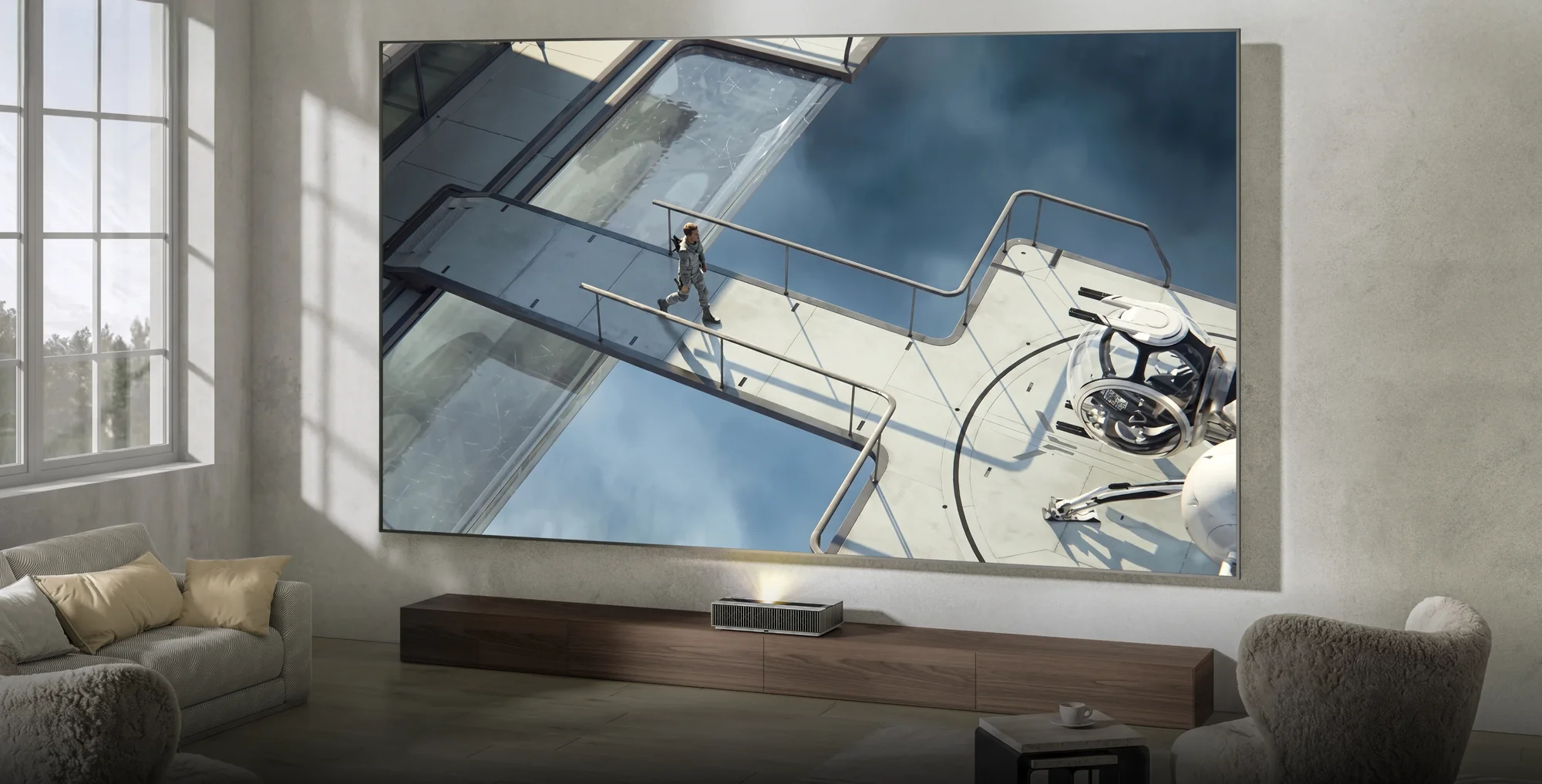
With its 0.18:1 throw ratio, AWOL Vision says LuxVision can fill screens from roughly 80 inches (203 cm) up to 200 inches (508 cm) while sitting just centimeters from the wall. Combined with the Optical Shift range, that gives installers more flexibility than most UST competitors when the media console isn’t perfectly centered on the screen.
Software and Connectivity
AWOL Vision is previewing a “One Screen, Four Experiences” multi-view feature that allows several wired and wireless sources to display simultaneously in a split-screen layout without additional hardware — useful for anyone who wants a sports feed and a group chat visible at once, or dual gaming setups. Full details on the operating system, app support, and audio hardware haven’t been published yet; AWOL Vision has said additional specifications will be revealed at the CEDIA and IFA press events.
Anti-RBE II
Rainbow artifacts — the brief flashes of separated red, green, and blue that some viewers notice on single-chip DLP projectors during high-contrast scenes — have been a target for AWOL Vision since its earliest products. LuxVision carries the second generation of the company’s Anti-RBE system, which AWOL says has been validated across more than 10,000 films. This won’t matter to most viewers, but it’s a meaningful selling point for the subset of buyers who are sensitive to DLP color breakup.
Price and Availability
Update (Sept. 3, 2026): Pricing is now official. LuxVision carries an MSRP of $5,999 in the US, €5,999 in Europe, and £4,999 in the UK, with market launch expected around October 2026 (AWOL Vision has not confirmed an exact ship date). This is a direct retail launch rather than a Kickstarter campaign, a departure from how the Aetherion Max reached buyers. AWOL Vision also confirmed the connectivity lineup: three HDMI 2.1 ports, a DisplayPort input, and 4-channel HDMI Multiview for running multiple sources at once, plus support for Dolby Vision, IMAX Enhanced, Filmmaker Mode, and 3D content alongside the gaming feature set.
How LuxVision Compares
| Spec | AWOL Vision LuxVision | AWOL Vision Aetherion Max | Hisense PX4 Pro |
|---|---|---|---|
| Light source | RGB triple laser | RGB triple laser | Trichroma laser |
| Resolution / Refresh | 4K, up to 120Hz | 4K, 60Hz | 4K, up to 240Hz (1080p mode) |
| Brightness | 6,000 ISO lumens (confirmed) | ~3,000+ ISO lumens class | Manufacturer-rated, FreeSync Premium certified |
| Throw ratio | 0.18:1 | ~0.19–0.25:1 class | UST class |
| Signature feature | Optical Shift (vertical image repositioning) | PixelLock alignment | AMD FreeSync Premium certification |
| Gaming | VRR, ALLM, 1ms claimed | Standard low-latency mode | 240Hz gaming mode, FreeSync |
| Price / Status | $5,999, launching ~October 2026 | Shipping now | Shipping ($3,998) |
For a full breakdown of the PX4 Pro, see our Hisense PX4 Pro review, or see how LuxVision stacks up directly against XGIMI’s competing flagship in our AURA 3 Max vs. LuxVision comparison. And if you’re weighing a UST purchase in general, our step-by-step 2026 buying guide is a good place to start before specs like these start blending together.
Who Should Wait for LuxVision
- Gamers building a big-screen console or PC setup who want VRR, ALLM, and low input lag without sacrificing UST convenience.
- Buyers with awkward media console placement who need Optical Shift’s vertical adjustment rather than physically moving furniture.
- Anyone sensitive to rainbow artifacts on single-chip DLP projectors, given the Anti-RBE II system.
- Design-conscious buyers who want a UST projector that looks intentional in a living room, not just functional.
Who Should Look Elsewhere
- Budget shoppers. At a $5,999 MSRP, LuxVision sits well above most UST projectors on the market.
- Buyers who need it immediately. With market launch expected around October 2026 and no exact ship date confirmed, this remains a pre-launch product.
- Buyers who prioritize independently verified specs. Brightness and contrast figures are now official manufacturer numbers, but still unconfirmed by third-party lab testing.
Pros and Cons
Pros: Genuine 4K/120Hz support in a UST form factor, a legitimately novel Optical Shift installation feature, wide color coverage claims, strong gaming spec sheet, and a fast follow-up that shows AWOL Vision isn’t standing still after Aetherion.
Cons: A premium $5,999 price tag, no exact ship date within the October 2026 launch window, contrast figures still not disclosed, and a very short gap since Aetherion shipped, which may frustrate recent buyers of that series.
Market Impact
LuxVision’s timing says as much as its spec sheet. It arrives right as IFA Berlin loses its three historic anchor brands in home projection — Epson, JVC, and Sony are all skipping the show this year — and Chinese and Chinese-adjacent brands like AWOL Vision, XGIMI, Hisense, JMGO, and Dangbei fill that vacuum. Epson isn’t disappearing from the market, though: the company has separately confirmed a new EH-LS5000/6000/7000/7500 laser 4K lineup with MediaTek-driven AI image processing, launching in Europe this same month, but through its own channels rather than the IFA show floor. The split says something about where the UST growth is actually happening right now — increasingly with the newer entrants, at trade shows built around fast product cycles.
Frequently Asked Questions
Is the AWOL Vision LuxVision available to buy yet?
Not yet, but pricing and specs are now fully confirmed. AWOL Vision officially unveiled LuxVision at IFA Berlin on September 3, 2026, with market launch expected around October 2026 at $5,999 (US) / €5,999 (EU) / £4,999 (UK).
What is Optical Shift?
It’s AWOL Vision’s term for true optical (not digital) vertical repositioning of the projected image, letting installers adjust image height without moving the projector or cropping the picture.
Is 6,000 lumens confirmed?
Yes. AWOL Vision confirmed 6,000 ISO lumens as an official spec at its IFA Berlin reveal on September 3, 2026, up from the 5,500 lumens figure that had circulated from press briefings before the official unveiling.
How does LuxVision compare to the Aetherion Max?
LuxVision sits above it, adding 4K/120Hz support, Optical Shift, and a claimed brightness increase, while the Aetherion Max remains AWOL Vision’s current shipping flagship.
Final Verdict
LuxVision looks like a genuinely differentiated UST projector rather than a spec-bump refresh — Optical Shift solves a real installation problem, and the 4K/120Hz gaming spec sheet, now backed by confirmed 6,000-lumen brightness and a $5,999 price, is ahead of most of the category. With official specs and pricing now locked in, the main open question is exact availability within the October 2026 launch window. We’ll update this article again once units start shipping and independent testing is available.
]]>