Aurzen EAZZE E1R/E1: Roku TV Mini Projector Launch
Aurzen isn’t only chasing flagship specs this IFA cycle — alongside the tri-fold ZIP Pro, the company also launched a genuinely different kind of product: the EAZZE E1 series, a pair of budget-friendly, under-one-pound smart mini projectors aimed squarely at bedrooms, dorm rooms, and first-time projector buyers rather than home-theater enthusiasts.
The lineup splits into two nearly identical models distinguished mainly by software: the Aurzen EAZZE E1R, which runs official Roku TV built in, and the Aurzen EAZZE E1, which uses Aurzen’s own Smart OS with a smaller set of licensed apps. Here’s everything confirmed about both.
Product Overview
Both E1 and E1R share the same core hardware: a compact body under one pound, native 720p resolution with 1080p content support, 160 lumens of rated brightness, and a 180-degree rotating built-in stand. The difference is entirely in the built-in software platform and initial regional rollout — E1R launched first in the United States and Canada, while E1 is launching in Germany, France, and Spain.
Design
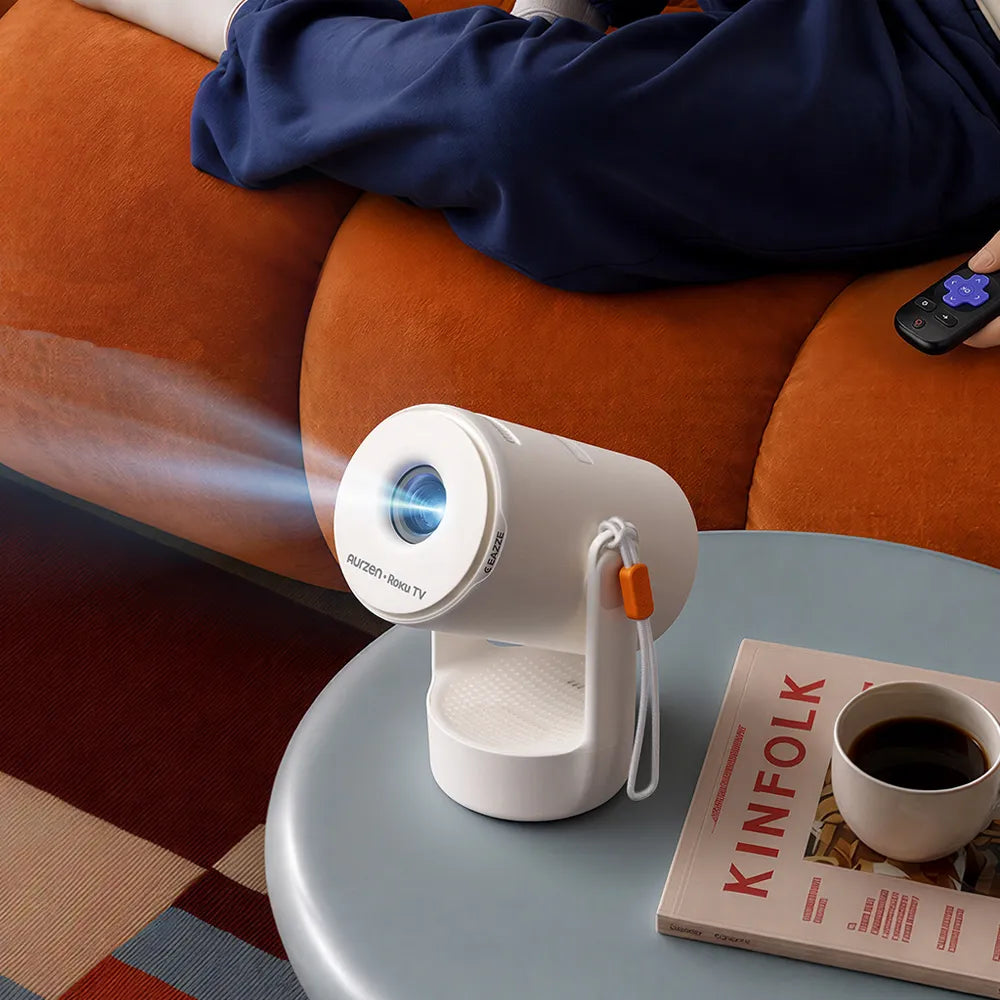
Aurzen is leaning into an approachable, non-technical design language here: a rounded, home-friendly body, an integrated 180-degree stand rather than a separate tripod, and a woven carrying strap built in. At under a pound, both models are light enough to move from a bedside table to a living room without much thought, and the stand is designed to let the projector aim at a wall or ceiling directly from a desk, shelf, or nightstand — genuinely useful for bedroom ceiling projection, where a permanent mount usually isn’t practical.
Display Technology and Resolution
Both models use a native 1280 x 720 pixel (720p) display and can accept input content up to 1080p, which the projector then scales down to its native 720p resolution for display. It’s worth being precise about that distinction, since “supports 1080p” and “native 1080p” mean different things: a native 1080p panel physically displays the full 1,920 x 1,080 pixel grid, while a 720p panel receiving 1080p content is downscaling that signal rather than displaying it at full resolution. Aurzen’s own materials are upfront about this rather than blurring the distinction, which is a point in the company’s favor on truth-in-advertising grounds — but it also means buyers should set expectations around a 720p-class image, not a Full HD one, despite the 1080p input compatibility.
Brightness
Both the E1 and E1R are rated at 160 lumens. That’s firmly in dark-room and evening-viewing territory — Aurzen’s own guidance recommends bedrooms at night, dorm rooms with curtains closed, and after-dark outdoor use rather than daytime or well-lit-room viewing. A smaller projected image will generally look brighter and clearer than pushing toward the 120-inch maximum, since the same amount of light is spread over less screen area.
Streaming Platform: Roku TV vs. Aurzen Smart OS
This is the actual differentiator between the two models. The EAZZE E1R has the official Roku TV platform built directly into the projector — not just Roku-compatible, but running Roku’s own interface, complete with the Roku home screen, Roku Smart Picture, Roku mobile app control, and access to Netflix, Prime Video, Hulu, YouTube, Apple TV, The Roku Channel, and other supported apps without an external Roku streaming stick. A Roku account and internet connection are required for activation, though creating an account is free.
The EAZZE E1, by contrast, runs Aurzen’s own Smart OS with a smaller set of officially licensed apps, including Netflix, Prime Video, and YouTube. It’s a simpler platform with less app breadth than Roku TV, positioned for regions where E1R isn’t launching first.
Picture Adjustment Features
The E1R specifically includes Roku Smart Picture, which automatically adjusts picture settings based on content type, alongside six manual picture-mode options: Movie, Sports, Vivid, Standard, and Low Power among them. Both models include auto vertical keystone correction, additional 4D electronic correction, zoom, and a manual focus wheel on top of the unit for fine-tuning image clarity — image adjustment tools aimed at making setup approachable for someone who’s never used a projector before.
Audio
Both models use a built-in 3W speaker paired with an approximately 80–100cc “Soundbase” resonance chamber — Aurzen’s attempt to give a small built-in speaker more body than the thin, tinny sound common on ultra-compact projectors. For more volume or private listening, both support two-way Bluetooth 5.2, which can either send the projector’s audio out to a Bluetooth speaker or headphones, or play audio from a paired phone or tablet through the projector’s own speaker.
Connectivity: WiFi, Bluetooth, AirPlay
- WiFi: Dual-band 2.4GHz and 5GHz, required for streaming and (on the E1R) Roku activation
- Bluetooth: Two-way Bluetooth 5.2 for audio in or out
- AirPlay: Apple AirPlay support for casting supported photos, video, and music from compatible Apple devices
Aurzen’s spec sheet doesn’t prominently list a dedicated HDMI or USB port in the E1R’s headline feature set — the projector is clearly designed around its built-in streaming platform and wireless casting rather than wired source connections, which is worth noting for anyone planning to connect a game console or external device directly.
Throw Ratio and Projection Size
Both models use a 1.12:1 throw ratio, supporting a projected image size from 20 to 120 inches. That throw ratio is considerably longer than the UST projectors we’ve covered from this same IFA cycle — this is a traditional standard-throw design, meaning the projector needs meaningfully more distance from the wall than a UST unit to fill the same screen size, which fits its bedside-table or shelf use case rather than a UST’s near-wall installation.
EAZZE E1R vs. EAZZE E1: Full Comparison
| Spec | Aurzen EAZZE E1R | Aurzen EAZZE E1 |
|---|---|---|
| Built-in platform | Official Roku TV | Aurzen Smart OS |
| Streaming apps | Roku home screen, Netflix, Prime Video, Hulu, YouTube, Apple TV, The Roku Channel | Officially licensed Netflix, Prime Video, YouTube |
| Native resolution | 720p | 720p |
| Supported content | Up to 1080p (scaled to 720p) | Up to 1080p (scaled to 720p) |
| Brightness | 160 lumens | 160 lumens |
| Stand | 180° adjustable | 180° adjustable |
| Weight | Under 1 lb | Under 1 lb |
| Initial launch regions | United States, Canada | Germany, France, Spain |
How the EAZZE E1 Series Fits Into Aurzen’s Lineup
Aurzen now runs three genuinely distinct product lines: the ZIP series (tri-fold pocket projectors, including the recently announced ZIP Pro), the EAZZE series (budget smart mini projectors, including this E1/E1R launch and the higher-spec 1080p EAZZE D1 line), and the BOOM series. The E1/E1R sit at the accessible end of the EAZZE range specifically — Aurzen’s existing EAZZE D1 Max and D1R air models offer native 1080p resolution and considerably higher brightness (up to 300 ANSI lumens on the D1R air), for buyers who outgrow what a 720p, 160-lumen unit can do.
Availability and Pricing
The EAZZE E1R launched in the United States and Canada in September 2026, with the E1 launching in Germany, France, and Spain. Aurzen has not published a fixed retail price in its official materials reviewed for this article; the company ran a pre-launch $1 voucher offer promising $30 off at launch through Amazon’s Aurzen Brand Store, suggesting a genuinely low entry price point consistent with the EAZZE line’s budget positioning. Current pricing should be confirmed directly on Aurzen’s product pages, since promotions and availability are subject to change.
Who Should Buy the EAZZE E1 or E1R
- First-time projector buyers who want something closer to a compact smart TV than a traditional home-theater setup
- Bedroom, dorm, or apartment use where a permanent TV or mounted projector isn’t practical
- Buyers who specifically want Roku’s interface built in without adding a separate streaming stick (E1R)
- Anyone prioritizing low weight and easy portability between rooms over image quality or brightness
Maybe look elsewhere if:
- You want native 1080p resolution — both E1 models are 720p native despite accepting 1080p input
- You need daytime or bright-room usability — 160 lumens is strictly a dark-room spec
- You want a dedicated home theater setup rather than a casual streaming projector
Pros and Cons
Pros: Genuinely lightweight and portable at under a pound, Roku TV built directly into the E1R (no streaming stick needed), a 180-degree stand that handles wall and ceiling projection without a separate mount, transparent messaging about native resolution versus content support, and an accessible price point aimed at first-time buyers.
Cons: 720p native resolution in a market where even budget projectors increasingly offer native 1080p, 160 lumens limits use to dark or dimly lit rooms only, no confirmed wired HDMI/USB input highlighted in the spec sheet, and no official price confirmed as of publication.
Market Impact
While the rest of this IFA cycle has been dominated by flagship 4K/120Hz UST launches costing thousands of dollars, the EAZZE E1 series is a reminder that a large part of the projector market is still about accessibility, not spec-chasing. By building Roku TV directly into a sub-one-pound, likely sub-$100 projector, Aurzen is competing less with XGIMI or AWOL Vision and more with the idea that a second TV is the only way to get a bigger screen in a bedroom or dorm room.
Frequently Asked Questions
What’s the difference between the Aurzen EAZZE E1R and E1?
They share identical hardware — 720p native resolution, 160 lumens, a 180-degree stand — but differ in built-in software. The E1R runs official Roku TV; the E1 runs Aurzen’s own Smart OS with a smaller set of licensed apps. They also launched in different regions initially.
Is the EAZZE E1R a native 1080p projector?
No. It has a native resolution of 1280 x 720 pixels and can accept 1080p input content, which is then scaled down to display at 720p.
Do I need a separate Roku streaming stick for the E1R?
No. The official Roku TV platform is built directly into the projector, so no external streaming stick is required.
How bright is the EAZZE E1/E1R, and can I use it during the day?
Both are rated at 160 lumens, which is suited to dark or dimly lit rooms — bedrooms at night, dorms with curtains closed, or outdoor use after sunset. Daytime or brightly lit rooms will wash out the image.
Can the EAZZE E1R project onto a ceiling?
Yes. Its built-in stand rotates through 180 degrees, letting it aim at a wall or ceiling from a table, shelf, or bedside surface.
How much does the EAZZE E1R cost?
Aurzen has not published a confirmed retail price in its official launch materials. A pre-launch promotional voucher suggested a budget-friendly price point; current pricing should be checked on Aurzen’s official product page.
Conclusion
The Aurzen EAZZE E1 and E1R aren’t trying to compete with this month’s flagship 4K/120Hz launches, and they’re honest about that — 720p native resolution and 160 lumens are clearly budget-tier specs. What they offer instead is genuine accessibility: Roku TV built directly into a sub-one-pound projector, a stand that handles wall and ceiling projection without extra hardware, and a setup experience designed to feel more like a compact smart TV than a traditional home theater component. For a first projector in a bedroom or dorm room, that trade-off is a reasonable one. We’ll update this article with pricing and availability details as Aurzen confirms them.