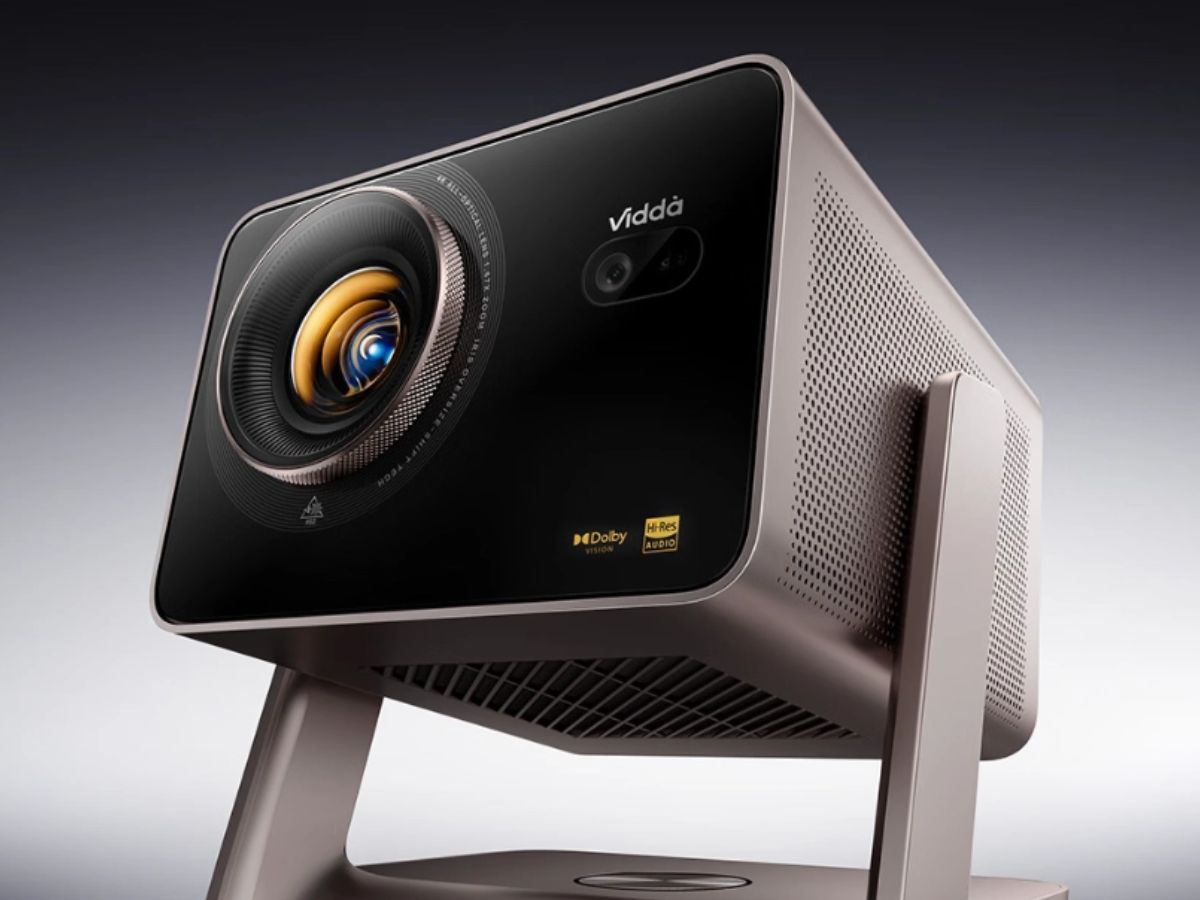
Hisense Vidda C5 Series Explained: Pro Max, Ultra, Ultra Max & Master Compared
Editorial note: Hisense’s Vidda C5 series launched in China back in May 2026, not this August — we’re covering it now to fill a gap in our lineup coverage, not because it’s breaking news. If you’re comparing current Hisense options, this is where the C5 family fits alongside the XR10 and Vidda LightGo we’ve already covered, and the older Vidda C3 series.
Product Overview
The Vidda C5 series is a four-model lineup — C5 Pro Max, C5 Ultra, C5 Ultra Max, and C5 Master — all sharing the same core platform: a Hubble movie lens, triple-laser light engine, VRR gaming support, and a JBL-branded 2.1-channel speaker system. It’s Hisense’s answer to the crowded mid-to-premium home laser projector segment, competing directly against XGIMI’s Horizon and JMGO’s N-series lineups on home turf in China, with global availability still unconfirmed.
Design
All four models share a common chassis design with the “Harper Movie Lens” branding and a similar 0.47-inch DMD-based optical engine, differentiated mainly by their laser configuration and brightness tier rather than a fundamentally different design language across the range — a fairly standard tiered-lineup approach.
Display Technology and Optical Engine
The line is built around Hisense’s QuaLas42 laser modules, with the number of laser units scaling by tier — the entry C5 Pro Max uses dual QuaLas42 lasers, while the higher-tier models step up brightness and contrast accordingly. All four use a 0.47-inch DMD chip paired with an MT9681 processing chipset, a combination that also shows up in other 2026-era Chinese laser projectors we’ve covered, including some Hisense UST models.
Brightness Across the Lineup
| Model | Brightness (CVIA) | China Price |
|---|---|---|
| C5 Pro Max | 3,200 CVIA lumens | ¥7,999 (~$1,175) |
| C5 Ultra | 4,400 CVIA lumens | ¥10,499 (~$1,455) |
| C5 Ultra Max | 4,700 CVIA lumens | ¥12,999 (~$1,800) |
| C5 Master | 5,800 CVIA lumens | ¥14,999 (~$2,080) |
Important caveat: CVIA lumens is a Chinese industry brightness standard, not the ANSI or ISO metrics used internationally. Given how many recent brightness-labeling corrections we’ve covered — including JMGO’s and AWOL Vision’s — treat these figures as directional rather than directly comparable to ANSI-rated projectors like ViewSonic’s LSD500-4K until Hisense confirms an international rating.
Resolution and Contrast
All four models offer native 4K UHD resolution. Contrast scales with the tier: the entry C5 Pro Max is rated at a 5,000:1 native contrast ratio, while the flagship C5 Master reportedly reaches 8,000:1 alongside liquid cooling — a feature typically reserved for a brand’s genuine flagship tier, since it allows sustained higher output without the fan noise that comes with air-cooled designs pushed to their limits.
Gaming Features
Every model in the C5 series supports VRR, a 240Hz refresh rate mode, and a claimed 1ms input lag — an aggressive gaming spec sheet across the entire lineup rather than reserved for just the flagship, which is a notable choice. That puts even the entry-level C5 Pro Max ahead of many competitors’ gaming specs at a similar price point.
Audio
All four models share a 2.1-channel speaker configuration: dual 8W tweeters, dual 10W full-range drivers, and a 20W subwoofer, badged with JBL branding — a meaningfully more robust built-in audio setup than most projectors in this price range offer.
Operating System and Connectivity
The China-market units ship with Hisense’s Android-based Vidda OS rather than Google TV, though a companion Google TV streaming stick (the “KD3”) is bundled or available as an accessory for markets or buyers who prefer that ecosystem. Wi-Fi 6 and Bluetooth 5.4 are standard across the lineup, along with HDMI 2.1 and 3GB/64GB of onboard storage on at least the Pro Max model.
Price and Global Availability
Pricing above reflects the China launch only. Hisense has not confirmed if or when the Vidda C5 series will reach the U.S. or European markets, where the brand currently sells the M2 Pro and the PX4 Pro UST models we’ve reviewed. Given Hisense’s release cadence this year, a global variant — likely under different branding, as with the XR10 — wouldn’t be surprising, but nothing is confirmed.
How the C5 Series Compares to the Older C3 Series
Per Hisense-focused buying guides, the meaningful jump from the previous C3 generation to C5 is the move to a new industrial-grade MCL3A laser chip, replacing the older MCL39 light source — a change that improves brightness, color gamut, and native contrast simultaneously, along with viewing comfort improvements Hisense attributes to the new laser’s characteristics.
Who Should Consider the C5 Series
- Gamers drawn to the 240Hz/1ms spec sheet across the entire lineup, not just the flagship.
- Buyers in China or importers comfortable sourcing directly, given the lack of confirmed global availability.
- Anyone comparing Hisense’s current lineup who wants to understand where C5 sits relative to the already-covered XR10 and Vidda LightGo.
Who Should Wait
- Buyers outside China should hold off until (or if) Hisense confirms international availability and ANSI/ISO-verified brightness figures.
- Anyone prioritizing a Google TV smart platform natively, rather than a bundled streaming stick, may prefer other Hisense models already sold internationally.
Final Verdict
The Vidda C5 series is a well-rounded, aggressively specced lineup by China-market standards — strong gaming features across every tier, a genuine flagship with liquid cooling, and pricing that undercuts a lot of international competition, at least before currency conversion and import costs. The open question is whether and how it reaches other markets, and until it does — with brightness figures converted to a standard most buyers outside China can trust — this remains a lineup worth watching rather than shopping for directly.
]]>