LG CineBeam HU925V: AI-Powered 4K UST Projector
While XGIMI, JMGO, and AWOL Vision have spent early September racing each other to native 4K/120Hz projection, LG has taken its new flagship UST projector in a different direction entirely. The LG CineBeam HU925V is the successor to the long-running HU915 series, and instead of chasing refresh rate, LG is betting on AI processing and wireless audio flexibility as its differentiators — headlined by a new α8 AI Processor Gen3, Google Gemini-powered search, and Dolby Atmos FlexConnect wireless speaker support.
Here’s a full breakdown of what LG has actually confirmed for the HU925V, based on the projector’s official listing.
Product Overview
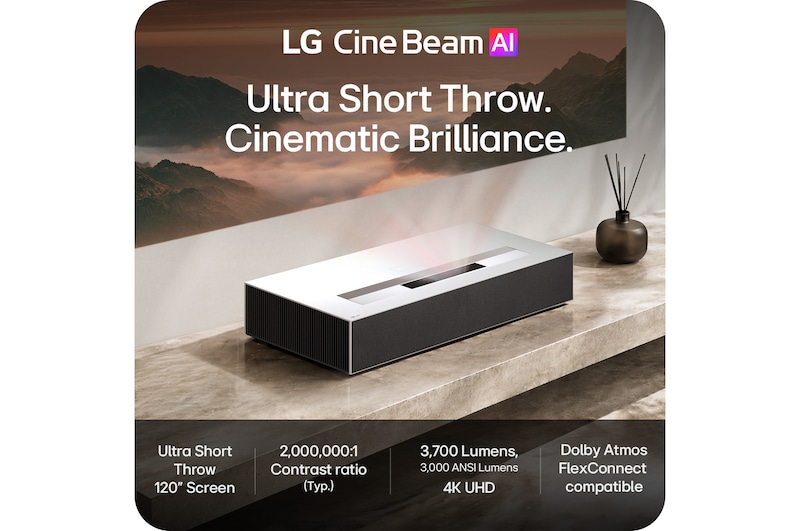
The HU925V is a single-model 4K UST laser projector, positioned as LG’s new flagship above the outgoing HU915QE and HU915QB. It keeps the same core UST formula LG has run for several generations — a laser light engine, webOS smart platform, and a close-to-wall installation — but layers in a substantially upgraded AI processor and a new wireless audio ecosystem feature that’s new to this generation.
Design
The HU925V ships in a two-tone finish — silver on the top and rear, black on the front and sides — supported by a fixed four-leg stand, with a ceiling mount hole and Kensington lock slot for installers who want it mounted or secured rather than sitting on a console. At 680 x 347 x 128mm and 12.7kg, it’s a substantial, mains-powered unit built for a fixed home-theater installation, not something meant to be moved between rooms.
Display Technology
LG’s light source is described as a “3Ch Laser” design — a blue laser diode, a red laser diode, and a second blue laser diode combined with a green phosphor wheel to generate the third primary color. LG markets this collectively as “RGB Laser,” though it’s worth noting this isn’t a pure three-laser (blue, green, and red laser diodes with no phosphor conversion) design the way some rivals’ flagships are — the green channel still relies on phosphor conversion from a blue laser source. LG rates the result at up to 94% DCI-P3 color coverage.
Processing is handled by LG’s new α8 AI Processor Gen3, which the company says delivers 5x faster NPU (neural processing unit) performance than its predecessor, running on a quad-core SoC. That extra processing power feeds directly into the projector’s AI Picture Pro and AI Sound Pro features, covered below.
Brightness
The HU925V is rated at 3,700 Lumens / 3,000 ANSI Lumens — LG publishes both figures side by side, since “Lumens” in LG’s own terminology reflects an internal testing standard meant to approximate perceived brightness, while ANSI Lumens is the more standardized, cross-brand-comparable measurement. For a fair comparison against other UST projectors, the 3,000 ANSI Lumens figure is the more directly comparable number, and it places the HU925V below the brightest current UST flagships (the AURA 3 Max and LuxVision are both rated well above 5,000 ISO lumens), though still well within usable range for moderately lit rooms.
Resolution and Refresh Rate — No 4K/120Hz Here
This is the most important spec to get right. The HU925V’s native resolution is 4K UHD (3840 x 2160), but LG’s own input signal compatibility table caps HDMI input at 4K resolution and 60Hz, 50Hz, or 24Hz refresh rates — there is no 4K/120Hz support. That puts the HU925V in a genuinely different category from the XGIMI AURA 3 Max, JMGO IRIS Ultra Max, and AWOL Vision LuxVision — all three of which we’ve covered as part of the current wave of native 4K/120Hz launches. If high-refresh gaming is a priority, the HU925V isn’t built for that use case; if AI-enhanced picture processing and flexible wireless audio matter more, that’s exactly where LG is focusing this generation instead.
Contrast and Uniformity
LG rates the HU925V at a 2,000,000:1 typical contrast ratio (measured full-on/full-off), with 85%+ uniformity per the JBMMA 9-point measurement standard — a spec that measures how evenly brightness is distributed across the projected image rather than concentrated toward the center. An Adaptive Contrast feature adjusts laser output scene-by-scene, brightening highlights while preserving shadow detail in darker content.
HDR Support
The HU925V supports HDR10 and HLG only — there’s no Dolby Vision or HDR10+ support confirmed in LG’s spec sheet, which is a notable gap compared to competitors like the AURA 3 Max (which supports Dolby Vision, HDR10+, HDR10, and HLG). LG does include HGiG (HDR Gaming Interest Group) mode, which helps games render HDR more accurately by having the display report its exact brightness capabilities to the console rather than relying on generic tone mapping, and Dynamic Tone Mapping Pro for adjusting brightness scene-by-scene on supported HDR content.
Gaming Features
Gaming support here is more modest than on the 4K/120Hz-focused competitors. The HDMI 2.1 port supports ALLM (Auto Low Latency Mode), which automatically switches to a low-latency picture mode when it detects a console, plus HGiG mode for accurate HDR gaming brightness. There’s no VRR (Variable Refresh Rate) support confirmed in LG’s spec sheet, and with input capped at 60Hz, this isn’t a projector built around high-frame-rate console or PC gaming the way this month’s other flagship launches are.
AI Features and Smart Platform
This is where the HU925V actually differentiates itself. It runs webOS 26 with a substantial AI feature set built around the new α8 processor:
- AI Picture Pro — includes AI Super Upscaling toward 4K quality and Dynamic Tone Mapping Pro, both designed to improve lower-resolution or poorly-mastered streaming content in real time
- AI Sound Pro — delivers virtual 11.1.2-channel surround processing from the built-in speakers, plus AI Object Remastering, which separates dialogue, music, and effects to remaster each independently for clarity
- AI Voice ID — recognizes individual users by voice signature and surfaces personalized content recommendations
- Generative AI search, powered by Google Gemini — lets users describe what they’re looking for in natural language rather than typing exact titles
- AI Magic Remote — a motion-sensor remote with a scroll wheel and voice command access to the AI features above
LG notes several of these features require webOS 26 specifically and an active internet connection with an LG account, and that generative AI features may vary by country and region.
Audio
Built-in audio comes from a 40W, 2-channel speaker system with Dolby Atmos pass-through support. The more distinctive feature is Dolby Atmos FlexConnect compatibility — this lets the HU925V act as a master device for LG’s wireless speaker ecosystem (compatible with LG’s H7 soundbar, and M7, M5, and W7 wireless speakers), automatically detecting each speaker’s physical position in a room and adjusting audio output in real time to build an immersive soundstage without wired speaker placement. Up to four additional speakers can be added when the projector itself is the master device. Note that Dolby Atmos FlexConnect does not work if the projector is ceiling-mounted or used for rear projection, and requires a Wi-Fi router, the LG ThinQ app, and the wireless speakers sold separately.
Connectivity: HDMI, USB, WiFi
- HDMI: 3 ports total — 1x HDMI 2.1 (ALLM, eARC, up to 24Gbps input, 4:4:4/RGB 10-bit output) and 2x HDMI 2.0
- USB: 2x USB 2.0 Type-A
- Ethernet: 1x RJ45 port for wired networking
- Audio out: 1x S/PDIF optical
- Wireless: AirPlay 2 (up to 4K/30Hz), Miracast screen mirroring (up to 4K/30Hz), Bluetooth (supports AV sync control and Bluetooth audio output)
Power Consumption and Noise Level
Maximum power consumption is rated at 350W, with standby power under 0.5W. Noise levels scale with the Eco/brightness mode selected: 26dB(A) at Eco Max, 28dB(A) at Eco Medium, 30dB(A) at Eco Min/Bright mode, and 32dB(A) at full/off-Eco maximum brightness.
Throw Ratio and Projection Size
The HU925V uses a 0.19 throw ratio with a fixed zoom and manual focus. LG’s official placement figures: a 90-inch image from 5.6cm off the wall, a 100-inch image from 9.8cm, and a 120-inch image from 18.3cm — putting its supported screen size range at 90 to 120 inches, somewhat narrower than the 200-inch maximums claimed by this month’s 4K/120Hz UST competitors. Setup is assisted by 4/9/15-point edge warping (an upgrade over simpler 4-corner-only keystone correction on older models), which can correct for uneven walls or off-angle placement, and LG provides an online Projection Calculator tool for planning installations before buying.
Comparison With the Previous Generation
| Spec | LG HU915QE (2022) | LG CineBeam HU925V (2026) |
|---|---|---|
| Brightness | 3,700 ANSI Lumens | 3,700 Lumens / 3,000 ANSI Lumens |
| Contrast | 2,000,000:1 | 2,000,000:1 (Typ.) |
| Color gamut | Not specified at this level | Up to 94% DCI-P3 |
| Processor | Not AI-branded | α8 AI Processor Gen3 |
| Smart platform | webOS (earlier version) | webOS 26 |
| Audio | 40W, 2.2ch | 40W, 2ch + Dolby Atmos FlexConnect |
| Edge correction | Basic keystone | 4/9/15-point warping |
| Max input refresh | 60Hz | 60Hz |
The HU925V’s improvements over the outgoing HU915 series are concentrated almost entirely in processing and software — AI upscaling, AI-remastered audio, generative search, and wireless speaker flexibility — rather than in the core optical brightness or contrast specs, which are roughly on par with the projector it replaces.
Comparison With This Month’s 4K/120Hz Launches
It’s worth being direct about where the HU925V sits relative to the other major projector news from the past two weeks. See our full roundup of confirmed native 4K/120Hz projectors for that comparison — the HU925V isn’t part of it, and buyers specifically shopping for high-refresh gaming performance should look at the AURA 3 Max, IRIS Ultra Max, or LuxVision instead. The HU925V’s case is built on AI picture/audio processing and wireless speaker integration, not gaming specs.
Availability and Pricing
LG has not published pricing for the HU925V as of this writing. For context, the outgoing HU915QE and HU915QB launched at $5,999 and $6,499 respectively, so a similar flagship-tier price is a reasonable expectation, but not confirmed. We’ll update this article once LG publishes official pricing and availability.
Who Should Buy the HU925V
- LG ecosystem buyers who already own or plan to buy LG’s wireless Atmos speakers (H7, M7, M5, W7) and want a projector that can act as the wireless audio hub
- Buyers who prioritize AI-enhanced picture upscaling and remastered audio over raw gaming performance
- Anyone who wants webOS’s mature app ecosystem and now, Gemini-powered natural-language search
Maybe look elsewhere if:
- You want native 4K/120Hz gaming performance — the HU925V caps at 60Hz
- Dolby Vision support matters to you — this generation supports HDR10 and HLG only
- You want the brightest or biggest-screen UST option — 3,000 ANSI lumens and a 120-inch max screen size are both more modest than current UST flagships from XGIMI and AWOL Vision
Pros and Cons
Pros: Genuinely capable AI picture and audio processing, Dolby Atmos FlexConnect wireless speaker integration is a real differentiator, mature webOS platform with Gemini-powered search, refined 15-point edge warping for tricky installations, and a proven light engine design carried forward from a well-regarded predecessor.
Cons: No 4K/120Hz or VRR support, no Dolby Vision or HDR10+, brightness and max screen size trail current UST flagships, no confirmed pricing yet, and several headline AI features require an LG account and constant internet connection to function.
Market Impact
The HU925V is a useful reminder that not every projector brand is chasing the same spec race. While XGIMI, JMGO, and AWOL Vision are all competing on native 4K/120Hz and raw brightness this cycle, LG is leaning into the two things its TV and audio divisions already do well — AI picture processing and a multi-device wireless speaker ecosystem — and applying them to its projector line instead of trying to out-spec the gaming-focused competition directly. Whether that’s the right bet depends entirely on what a given buyer actually wants from a UST projector.
Frequently Asked Questions
Does the LG CineBeam HU925V support 4K at 120Hz?
No. LG’s official specifications cap HDMI input at 4K resolution with 60Hz, 50Hz, or 24Hz refresh rates — there is no 4K/120Hz support on this model.
Does the HU925V support Dolby Vision?
No. Confirmed HDR support is limited to HDR10 and HLG.
How bright is the LG CineBeam HU925V?
LG rates it at 3,700 Lumens / 3,000 ANSI Lumens, with a 2,000,000:1 typical contrast ratio.
What is Dolby Atmos FlexConnect?
It’s a wireless surround-sound technology that lets the HU925V act as a master device for LG’s wireless speakers (H7, M7, M5, W7), automatically detecting speaker placement in a room and adjusting audio output accordingly, without needing wired speaker connections.
How much does the HU925V cost?
LG has not published pricing as of this writing. Its predecessor, the HU915QE, launched at $5,999.
Conclusion
The LG CineBeam HU925V isn’t trying to compete on the same terms as this month’s 4K/120Hz UST launches, and it’s worth evaluating on its own terms rather than penalizing it for skipping a spec other brands are chasing. For buyers who care more about AI-enhanced picture quality, a mature smart platform, and genuinely useful wireless audio integration than about gaming refresh rates, the HU925V’s feature set is a real, differentiated pitch. We’ll update this article as soon as LG confirms pricing and availability.


