Hisense C3 Ultra & C3 Ultra Max: 5,000-Lumen Laser Debut
Hisense C3 Ultra and C3 Ultra Max: A New Triple-Laser Benchmark for Home Projection
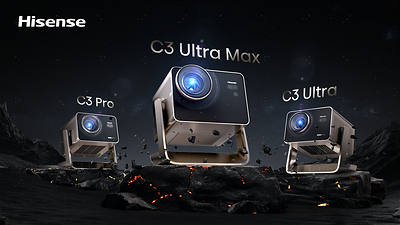
Hisense just widened the gap between “projector” and “home cinema centerpiece.” On September 15, 2026, the company officially unveiled its new C3 projector family — headlined by the C3 Ultra and C3 Ultra Max — as part of a global rollout that was first shown off at IFA 2026 in Berlin. A third model, the C3 Pro, is confirmed to follow later, rounding the family out into a full good-better-best lineup.
If you’ve been holding off on a living-room upgrade waiting for laser projection to get brighter, bigger, and more gaming-friendly without turning into a five-figure investment, this is the launch worth paying attention to. Here’s everything confirmed so far, what it means if you’re shopping this season, and how it stacks up against the rest of the 2026 projector field.
Product Overview
The C3 family is Hisense’s answer to a question more households are asking every year: do we actually need a 100-inch-plus TV, or can a projector do the job better, cheaper, and with less wall-mounted commitment? The C3 Ultra and C3 Ultra Max are both designed to scale from a modest bedroom size up to a genuinely massive 300-inch image, all while leaning on triple-laser light engines rather than traditional lamp or single-laser designs.
Both models are shipping under Hisense’s broader Laser Home Cinema strategy, a lineup the company has been building out since it launched its first laser projector back in 2014. According to Hisense’s own citation of Omdia data, the company already ranks number one globally in the 100-inch-and-larger TV display segment, and it’s clearly trying to carry that scale advantage over into projection.
Design
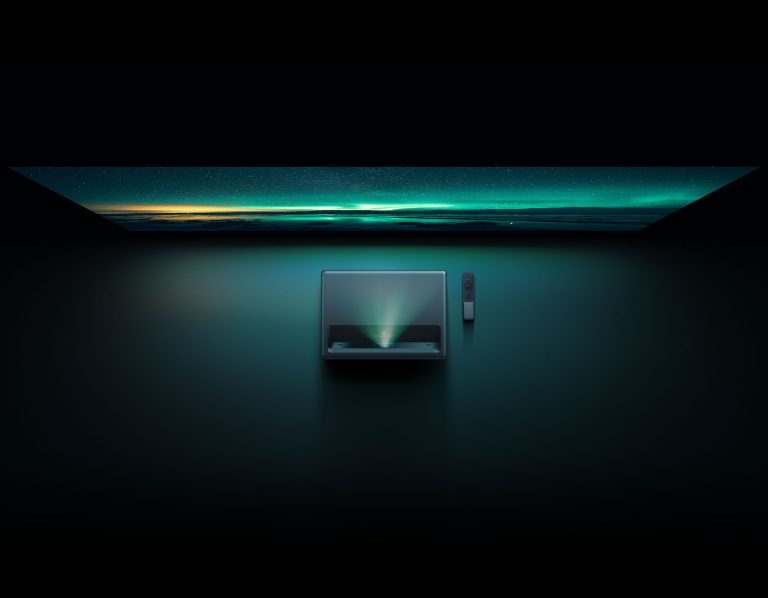
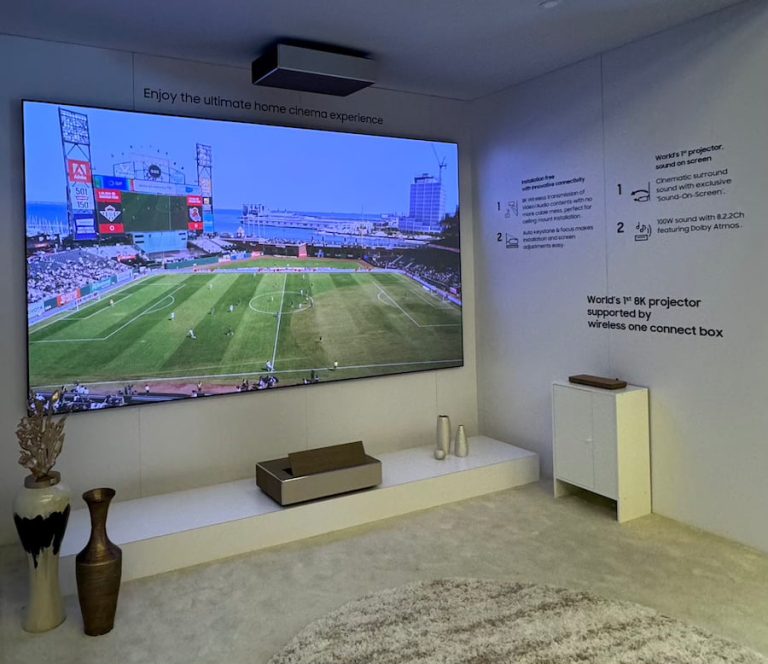
While Hisense hasn’t published full teardown-level design details yet, the C3 family follows the ultra-short-throw (UST) form factor that’s become the default for premium home laser projectors: a low-profile chassis that sits on a media console just inches from the wall or screen, avoiding the ceiling mounts and long cable runs that traditional projectors require. That matters more than it sounds — a UST design is what lets a projector realistically replace a TV in a normal living room instead of requiring a dedicated home theater room.
Display Technology: Triple Laser and the IRIS Lens
The headline engineering story here is the triple-laser (RGB) light source, paired with what Hisense calls an IRIS Lens system. In plain terms:
- Triple laser (RGB laser) means the projector generates red, green, and blue light directly from three separate laser diodes rather than a single blue laser bouncing off a phosphor wheel. This produces a wider, more accurate color gamut and generally better color volume at high brightness — a technology Hisense has branded around its “RGB MiniLED” leadership on the TV side and is now pushing into projection.
- IRIS Lens is a dynamic aperture system that adjusts in real time based on scene content and ambient light, similar in concept to the iris systems recent high-end UST projectors have adopted to fight one of laser projection’s oldest weaknesses: washed-out black levels in bright rooms.
Together, these two pieces are what let Hisense claim gaming-enhanced performance alongside cinema-grade color — a combination that’s historically been a trade-off.
Brightness
This is where the two new models split:
- Hisense C3 Ultra: 4,000 ANSI lumens
- Hisense C3 Ultra Max: 5,000 ANSI lumens
ANSI lumens is the industry-standard measurement that matters more than “raw lumens” figures thrown around by cheaper projectors, because it reflects actual usable brightness across the full image rather than a peak-brightness marketing number. At 4,000–5,000 ANSI lumens, both models are squarely in daytime-viewable territory for UST laser projectors — bright enough to hold up against ambient light from windows, something budget projectors in the 1,000–2,000 lumen range simply can’t do.
Resolution
The C3 family is confirmed as 4K, which for a laser projector in this class typically means native or pixel-shifted 4K output rather than a lower native panel resolution upscaled digitally. Hisense hasn’t yet detailed the underlying panel technology in public specs, so we’ll update this article once that’s confirmed.
Contrast
Hisense has confirmed a 5,000:1 contrast ratio on the C3 Ultra, driven in large part by the IRIS Lens’s dynamic aperture. For context, that puts the C3 Ultra ahead of many earlier-generation UST laser projectors, which often struggled to break 3,000:1 without external ALR (ambient light rejecting) screens.
HDR
Full HDR format support hasn’t been itemized in the initial press materials. Based on Hisense’s prior C-series and PX-series projectors, HDR10 support is a near-certainty; we’ll confirm and update once official spec sheets or hands-on reviews from outlets like ProjectorCentral and Notebookcheck are published.
Gaming Features
Hisense specifically called out gaming-enhanced performance as part of the IRIS Lens system’s design goals, positioning the C3 Ultra and Ultra Max as viable for living-room gaming sessions — not just movie nights. The C3 Ultra Max is confirmed to deliver 1ms ultra-low latency, a figure that puts it in serious contention with dedicated gaming projectors and monitors rather than just casual living-room play. Full refresh-rate specs haven’t been itemized yet, which is the detail competitive gaming projector buyers will want to watch for once independent reviewers get hands-on units.
Operating System
Not yet detailed in the initial announcement. Hisense’s recent projectors (including the PX-series shown at CES 2026) have generally shipped with a smart TV platform built in; expect confirmation as retail listings go live.
Audio
Hisense confirmed both models ship with Devialet-tuned audio. The C3 Ultra pairs this with a built-in subwoofer for deeper bass; Hisense’s release describes the tuning as delivering room-filling surround sound rather than requiring an external soundbar. Devialet is a recognized name in premium audio, and building that partnership into a projector’s speaker system is a meaningful step up from the generic built-in drivers common in this category.
Connectivity (WiFi, Bluetooth, USB, HDMI)
Detailed port and wireless specs haven’t been published in the initial press release. We’ll update this section the moment full spec sheets go live on Hisense’s regional sites.
Power Consumption, Noise Level, Throw Ratio
Not yet published. These are exactly the kind of numbers that show up in full spec sheets and hands-on reviews rather than launch press releases, so treat any figure you see elsewhere right now as unconfirmed until it’s sourced to Hisense directly or a verified reviewer.
Projection Size
Both the C3 Ultra and C3 Ultra Max are rated for image sizes up to 300 inches, with the C3 Ultra Max specifically listed across a 65-inch to 300-inch range. That’s an enormous span — the 65-inch low end means these projectors can realistically function as a primary display in smaller rooms too, not just as a dedicated big-screen setup.
Price and Availability
Hisense has not published U.S. or regional pricing for the C3 Ultra or C3 Ultra Max as of this writing. What is confirmed is the timeline: both models are launching across global markets this September 2026, with the C3 Pro to follow afterward. We’ll update this article the moment retail pricing goes live — bookmark this page or check back rather than relying on any third-party price estimate currently circulating.
Comparison with the Previous Generation
Hisense’s prior flagship UST projector, the PX3-Pro, helped establish the company as a serious player in the premium laser projector space. The step-up story with the C3 family is brightness and contrast: the C3 Ultra Max’s 5,000 ANSI lumens and 5,000:1 contrast ratio represent a meaningful jump for daytime and ambient-light usability, while the added IRIS Lens system directly targets the black-level weakness that’s historically been the Achilles’ heel of bright laser projectors.
Comparison with Competitors
| Projector | Light Source | Peak Brightness | Max Image Size | Contrast | Category Position |
|---|---|---|---|---|---|
| Hisense C3 Ultra Max | Triple RGB laser | 5,000 ANSI lumens | 300″ | 5,000:1 | New flagship, Sept. 2026 |
| Hisense C3 Ultra | Triple RGB laser | 4,000 ANSI lumens | 300″ | 5,000:1 | New mid-flagship, Sept. 2026 |
| Hisense PX3-Pro | Triple laser | Lower than C3 family | Up to ~130″ | Lower | Previous-gen flagship UST |
| AWOL Vision Aetherion Max | Triple laser | High-brightness UST | Large-format | Competitive | CES 2026 rival, targets focus/fringing issues |
| Samsung The Freestyle+ (2nd Gen) | LED | Modest, portable-class | Small-to-mid | Lower | Portable category, not a direct rival |
| Epson Lifestudio Grand UST (2025 lineup, for context only) | 3LCD RGB LED | 3,600 lumens | Up to 120″ | Not laser-class | Prior-year, lower brightness tier |
The most direct competitive pressure on the C3 Ultra Max comes from other 2026 UST flagships like the AWOL Vision Aetherion Max, which is also chasing brightness and image-quality fixes in the same premium tier. Against older 3LCD lifestyle projectors like Epson’s Lifestudio Grand (a 2025 release, included here only for scale comparison), the C3 family’s laser brightness and 300-inch ceiling are in an entirely different weight class — though Epson’s line competes on price and portability rather than raw performance.
Who Should Buy the C3 Ultra or C3 Ultra Max
- Home theater enthusiasts who want TV-killing screen size (100″+) without a dedicated blackout room, thanks to the brightness headroom.
- Sports and gaming households drawn in by the IRIS Lens’s gaming-enhanced positioning and the sheer scale of a 300-inch image for game nights.
- Anyone replacing an older lamp-based or single-laser projector who wants a meaningful jump in color accuracy and contrast.
Who might want to wait: buyers who need confirmed pricing, HDR format details, or independent brightness/contrast testing before committing — all reasonable to wait for given how little of the deep spec sheet has been published so far.
Pros
- Triple RGB laser light source with strong ANSI lumens figures for the category (4,000 / 5,000)
- IRIS Lens dynamic aperture targeting the bright-scene contrast weakness common in UST laser projectors
- Massive projection range up to 300 inches, with the Ultra Max scaling down to 65 inches too
- Part of a full three-tier family (Ultra, Ultra Max, and the upcoming Pro), giving buyers room to pick a price/performance point
- Backed by Hisense’s broader RGB laser and MiniLED display R&D, not a one-off product
Cons
- No official pricing announced yet, making it hard to judge value against competitors today
- HDR format support, ports, and OS platform are still unconfirmed (audio is now confirmed as Devialet-tuned)
- Throw ratio and noise level — both critical for real-world room planning — haven’t been published
- The C3 Pro, arguably the most budget-accessible model in the family, hasn’t launched yet
Market Impact
This launch reinforces a trend that’s been building across 2025 and 2026: premium projector brands are treating brightness and contrast as the new battleground, the same way TV makers fought the “nits war” a few years ago. Hisense entering this fight with a three-tier family, rather than a single flagship, signals it wants to own multiple price points simultaneously — a strategy that puts direct pressure on XGIMI, AWOL Vision, and even Samsung’s projector ambitions heading into the CEDIA and holiday shopping season.
The C3 Pro: The Budget-Friendly Entry Point
Hisense has now confirmed the C3 Pro’s specs alongside the Ultra and Ultra Max, rather than leaving it a total unknown. The C3 Pro delivers 3,000 ANSI lumens with the same 5,000:1 contrast ratio and IRIS Lens system as its siblings, plus Devialet-tuned audio with a built-in subwoofer. In other words, the entire C3 family shares its core image-quality DNA — brightness is the main lever separating the three tiers, which makes shopping the lineup considerably simpler than it looks at first glance.
Future Availability
Expect regional pricing to roll out through the rest of September 2026 as the “global markets” launch Hisense referenced takes effect market by market. With the C3 Pro’s specs now confirmed alongside the Ultra and Ultra Max, the main remaining question is pricing across all three tiers — that’s what’s worth watching for before you buy.
Frequently Asked Questions
When were the Hisense C3 Ultra and C3 Ultra Max announced?
Hisense officially unveiled both projectors on September 15, 2026, following a showcase at IFA 2026 in Berlin, with global market launches beginning that same month.
What’s the difference between the C3 Ultra and C3 Ultra Max?
Brightness is the primary confirmed difference: the C3 Ultra delivers 4,000 ANSI lumens, while the C3 Ultra Max steps up to 5,000 ANSI lumens. Both share the triple-laser light source, IRIS Lens system, 5,000:1 contrast ratio, and up-to-300-inch projection size.
How much do the Hisense C3 Ultra and C3 Ultra Max cost?
Hisense has not announced pricing yet. We’ll update this article as soon as regional retail pricing is confirmed.
Is the C3 family good for gaming?
Hisense specifically designed the IRIS Lens system with gaming-enhanced performance in mind, though detailed input-lag and refresh-rate specs haven’t been published yet.
What is the Hisense C3 Pro?
The C3 Pro is the third model confirmed as part of the C3 family, expected to follow the Ultra and Ultra Max. No launch date has been announced.
Is the C3 Ultra Max a true ultra-short-throw projector?
Yes — the C3 family follows the UST form factor common to premium laser home theater projectors, designed to sit close to the wall or screen rather than requiring a ceiling mount.
Conclusion
The Hisense C3 Ultra and C3 Ultra Max aren’t a minor spec bump — they’re Hisense staking a claim to the top of the 2026 UST projector conversation with real brightness numbers (4,000 and 5,000 ANSI lumens), a genuinely large top-end screen size, and a contrast-focused IRIS Lens system built specifically to fix laser projection’s biggest weakness. With pricing and the remaining spec sheet still to come, this is very much a “watch this space” launch — but it’s one that immediately reshapes what buyers should expect from a flagship home projector this year. We’ll be updating this article the moment Hisense confirms pricing and full specifications, so check back before you buy.
Sources: Hisense official press release via PR Newswire (Sept. 15, 2026), cross-verified across multiple wire syndications.